
Professor Susan Ravizza, a cognitive neuroscientist at MSU, has devoted her career to exploring working memory, attention, and cognitive control. Dr. Ravizza has always been interested in how people think. Even as an undergraduate, she was known for her talent for finding misplaced books in the library where she worked.
"I really enjoyed figuring out how books were misshelved,” said Dr. Ravizza. “I would kind of put myself in the mind of someone else and ask things like ‘If I was reshelving these books, what mistakes would I make?’ Instead of seeing the letter b I might think that's a d because they look similar. I didn’t know it at the time but, I was thinking about cognitive processes.”
This curiosity about attention and memory propelled her to pursue her Ph.D. in psychology at The University of California, Berkeley and then a postdoctoral fellowship at the University of Pittsburgh. There she learned how to combine functional Magnetic Resonance Imaging (fMRI) with behavioral methods to answer her cognitive questions. This allowed her to understand cognitive processes that are involved in attention and memory from both mind and brain perspectives.
Research on Attention and Memory
One of Ravizza's primary areas of research has been the impact of distractions on academic performance. Her research has shown that all students, even academically strong students, are affected by off-task internet use during class. She explains that when bringing a laptop to class, students are prone to become distracted and start checking emails or working on other assignments, which reduces their attention and ability to encode information into their memory.
Ravizza's research has far-reaching implications for education and the study of cognitive processes. Her findings underscore the negative effects of digital distractions on learning and highlight the importance of actively engaging with information to enhance cognitive processing. By highlighting the impact of attention on memory encoding, Ravizza's work helps educators and students alike develop effective strategies for learning and retaining information.
Ravizza also discusses her research on how individual personality differences relate to learning in synchronous and asynchronous online courses. Her study suggests that high impulsivity is associated with more detrimental performance in synchronous classes, where there is a structured schedule, than in asynchronous classes, where students have more control over when they engage with the material. Introversion, on the other hand, is more related to success in asynchronous classes.
In her own classes, Ravizza emphasizes the importance of creating predictable locations for important information on lecture slides to help students direct their attention to the most critical points. By consistently placing important information in the same location, students learn unconsciously that this location is significant, just like knowing that the leader usually sits at the head of the table. She also advises students to avoid using their computers to take notes and to think deeply about what each slide and graph mean so that information gets encoded in memory right away. If people do need to take notes on the computer, she has also asked them to sit in the back of the class to minimize distractions for others.
Working memory, which Ravizza studies, lasts only a few seconds but can be extended through rehearsal. Information in working memory is more likely to be transferred to long-term memory if it is given enough attention and meaning. When studying, teaching the information to another person can also help encode the information in your long-term memory.
Flexible Attention
Dr. Ravizza’s current research project involves studying how flexible attention is. Her goal is to better understand how attention works and how people can improve their memory and cognitive processes. Her study involves changing the percentage of importance that people assign to remembering a certain color, and then testing whether people can adjust their attention to match the changing probability.
 In her study, participants are given two colors and told that one of the colors is more likely to have to be recalled. Throughout the study, they change the likelihood that a color will have to be recalled testing whether people can calibrate their attentional resources based on this information.
"It does look like people can set their attention by these increments but only if I tell them before they’ve encoded the colors,” said Ravizza. “Once you have that information in mind, it's harder for your attention to be flexible. So, we’re seeing that attention seems less flexible for things that are already in memory.”
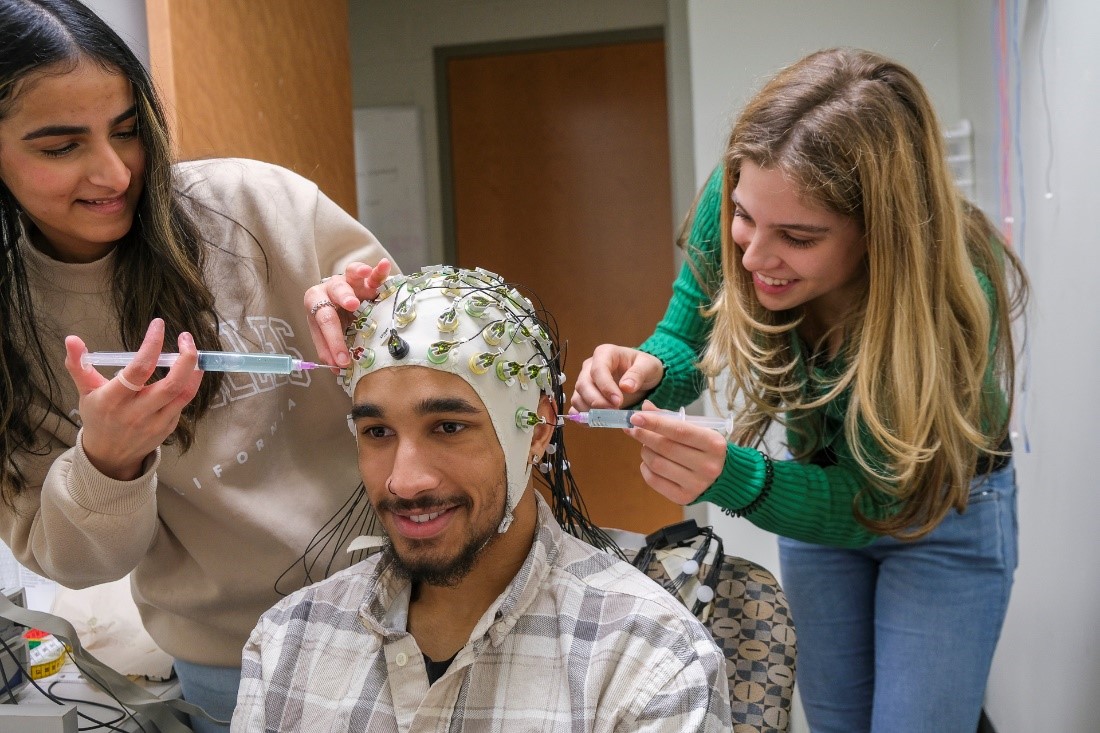
Ravizza is also interested in using electroencephalography (EEG) to decode what is in memory and how this changes with attention. In her EEG study, Ravizza and her team record electrical signals from electrodes on a participant's scalp as they are asked to remember different colors. They then analyze the pattern of electrical signals to determine what color the person is remembering. If the color is attended, the color that the participant is remembering can be decoded based on the electrical activity patterns from the brain. Without attention, it is not possible to decode what color is in memory.
Overall, Ravizza's research sheds light on the importance of attention and memory in adapting to changing environments and provides practical advice for educators and students alike. As technology continues to evolve, it is essential to understand how it affects our cognitive processes and to develop effective strategies for leveraging it in educational settings.