
In today's world, success demands more than book smarts - it requires practical skills, adaptability, and a forward-thinking mindset. Our program is designed to empower you with the tools, techniques, and insights needed to excel in the field of Industrial and Organizational Psychology.
The program is geared to working professionals who are looking to enhance their skill set for career development and advancement. We understand the unique needs of adult learners, and that's why we offer five-week courses that fit seamlessly into your busy lives. Our curriculum emphasizes hands-on learning, portfolio building projects, and learning from top experts in the field. You will hone your skills in talent assessment, survey design, data analysis, organizational management, and more, making you valuable to any organization.
With our Master's Degree in Work and Organizational Psychology, you'll graduate not with just a diploma but with the confidence and competence needed to drive positive change in the ever-evolving world of work.
We conducted interviews with leading experts working in the areas of people analytics, talent management, and organizational and team effectiveness to identify critical competencies for a successful specialist in work and organizational psychology. Our curriculum is designed to build and strengthen your competencies in these areas.
Our master's program offers a unique advantage to you in the job market by providing practical, hands-on experience that develops skills relevant to solving real-world problems. One key aspect of our program is the emphasis on building valued quantitative and data analytic skills. Through practical coursework and projects, you will apply these skills to real-world scenarios, gaining invaluable experience that sets you apart from other job candidates. By creating a professional portfolio of your work throughout the program, you will demonstrate a readiness to tackle complex workplace challenges.
Our program instructors include leading experts in the field of work and organizational psychology who have been recognized for their work by numerous awards from the Society for Industrial and Organizational Psychology. Instructors consist of highly respected faculty members from Michigan State University's top-ranked doctoral program in organizational psychology. Alumni of the doctoral program, who are actively engaged in the field of work and organizational psychology, also serve as instructors. Thus, students will be informed by the rigorous scientific findings and evidence-based best practices.
"I'm in the thick of this master’s program and really enjoying it. Strong faculty, thoughtful discussions, and coursework that’s practical and directly applicable to my current work and where I’m headed next. The cohort is exceptional bringing perspectives from across industries and sectors, which makes the learning even richer. I'm grateful for the experience." - Robin Reibe, MSU Graduate Student

In our Work and Organizational master's program, our educational goals are clear. One objective is to ensure you have a deep understanding of people issues at work, strategies for problem solving, and industry best practices. This knowledge is essential for anyone looking to excel in the dynamic field of organizational psychology.
Our second objective is to prepare you for success in a range of master's-level positions across various professional settings. Our program is about skill building for real-world readiness and ability to thrive in diverse environments.
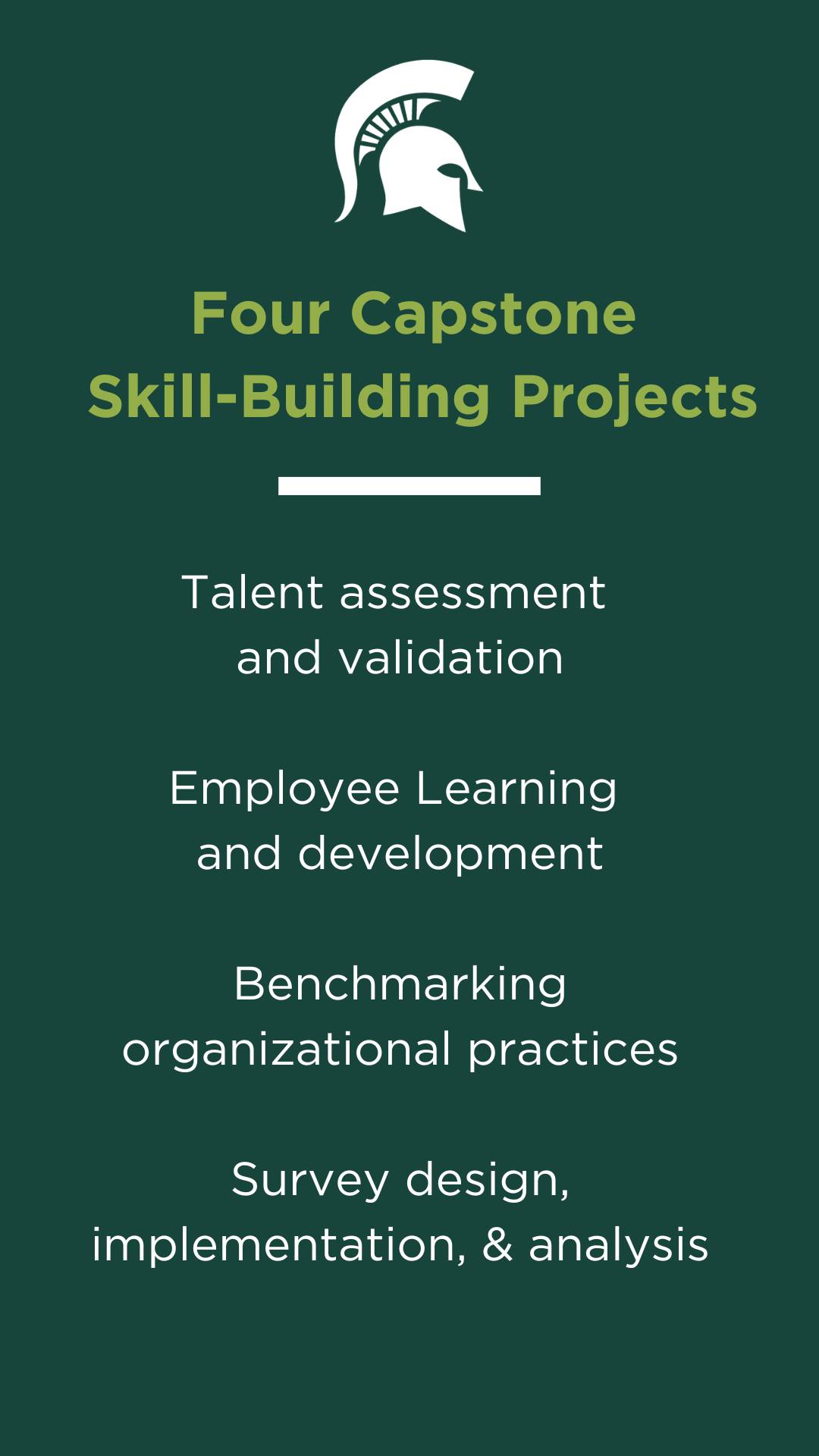
We achieve these two goals through coursework and the completion of four capstone skill-building projects. The projects focus on talent assessment and validation, employee learning and development, benchmarking organizational practices, and survey design, implementation and analysis. These projects are directly relevant to duties performed as an Industrial and Organizational Psychologist and provide you with a portfolio to demonstrate your expertise in these areas.
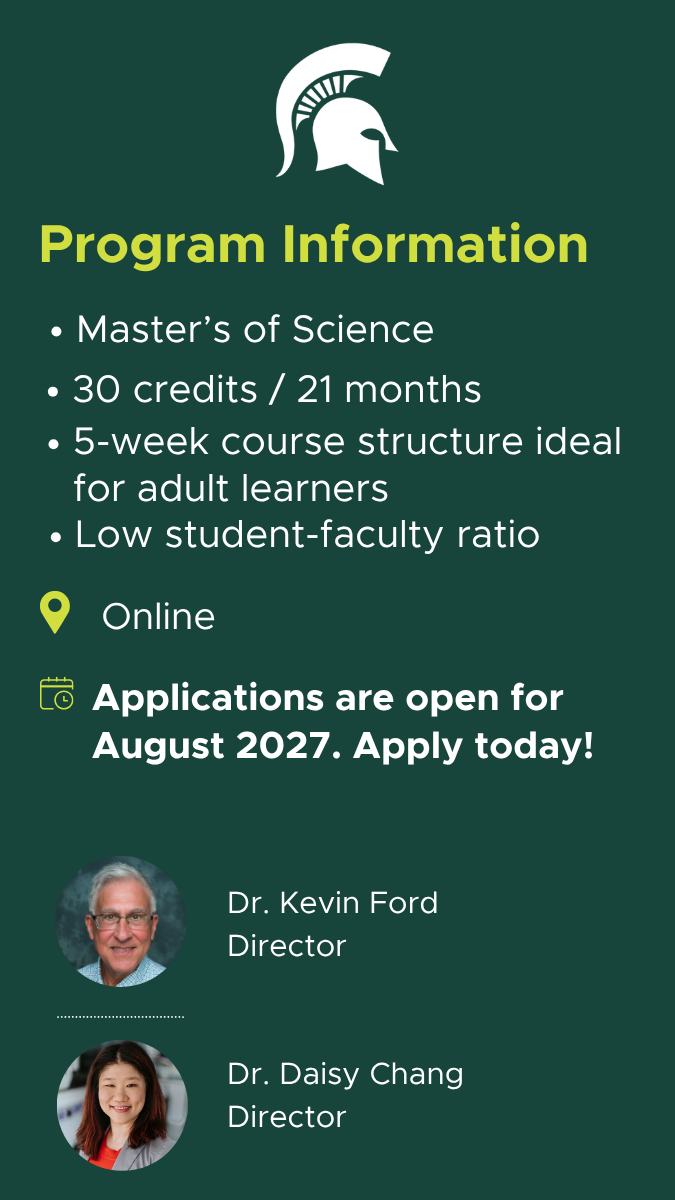
The MS program is structured around two innovative components. First, rather than the typical academic model of semester long courses, each of our courses is five weeks in duration. You will take only one course at a time so you can concentrate on the course materials and assignments. This innovative approach will allow you to take three 5-week classes within the traditional academic semester.
Secondly, learning and application of knowledge and skills gained requires a team effort among the faculty and the students in the program. Therefore, a foundation for our program is the creation of a cohort model where students enter and complete the program together as a learning team. The cohort model also allows the program directors to coordinate the courses and monitor the progress of the cohort to aid in accelerating learning and development. A new cohort starts the third week of August each year. For each cohort the time to completion is less than two years (22 months).
In addition, be assured that embedded into every aspect of our program are the values of collaboration, truth, integrity, and diversity. In this program, you can expect an education that goes beyond traditional academic boundaries. We aim to not only equip you with practical skills but also nurture your intellectual curiosity, social responsibility, and creativity. By embracing discovery and staying ahead of industry trends, we will prepare you for the challenges of tomorrow.
Based on the most recent employment and salary survey of the Society for Industrial-Organizational Psychology, those who recently received their master’s degree had a median salary of $65,000, which increased significantly as they accumulated more work experiences (e.g., $87,500 for those 2-4 years after degree completion, and $99,174 for those 5-9 years after degree completion). Clearly, individuals with a master’s degree in work and organizational psychology have skillsets that are highly desirable in the labor market.
Job titles for recent graduates of those with a master’s degree may include specialist, consultant, and senior consultant. As individuals accumulate experience in this field, they may move into positions with titles such as Human Resources Manager, Director, Vice President in Human Resources, and Senior Vice President in Human Resources.
The program has been approved and is eligible for federal student loans. In addition, private loans and MSU scholarships are available to qualified graduate students. For more information, please see the Office of Financial Aid at MSU.
All students must complete 30 credits with a 3.0 minimum cumulative grade-point average.
All students must complete the following nine courses (18 credits total):
All students must complete four practicum courses (8 credits total)
Special Students complete 2 Special Topics seminars to meet the minimum requirement of 30 credits (4 credits total)
To get a sense of workload and expectations, here are a set of syllabi from a previous year:

I am a professor of Psychology at Michigan State University whose major focus is on workplace learning and development and organizational change. My consulting work includes working with various private and public sectors on training, leadership, strategic planning and organizational development issues.
As a researcher, I have published over 100 articles and chapters and six books including my recent textbook on “Learning in Organization: An Evidence-Based Approach”. My contribution to the field has been recognized by my election as Fellow of the Society of Industrial and Organizational Psychology (SIOP) and I recently received the Scientist-Practitioner Award from SIOP.
My BS in psychology is from the University of Maryland and my MA and Ph.D. in psychology is from The Ohio State University.
Learn more about Dr. Ford here.

In my research, I strive to improve employee health, well-being, and safety by enhancing our understanding of the socio-cognitive and motivational processes that influence behaviors in organizational settings. I am particularly interested in identifying psychological processes that not only account for behavioral criteria that have been the traditional focus of industrial and organizational psychology, but also criteria related to occupational health and safety.