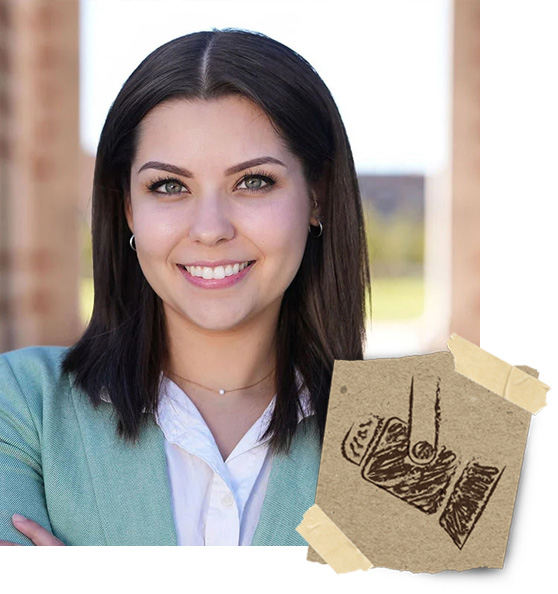
Our Access Spotlight for the month of September as we celebrate Hispanic Heritage Month is Jo Alanis, a Postdoctoral Associate in the Office of Access and Institutional Excellence at Rice University who earned her Ph.D. in Organizational Psychology from Michigan State University.
Alanis was first drawn to the field of Industrial/Organizational Psychology when she became a research assistant on a project through the Provost’s office at University of Houston focused on ways to support and advance women faculty at the university. From there, she did an honors thesis examining the consequences of tenure clock extensions for women in academia. She had always been passionate about topics around diversity, equity, inclusion, work-life balance and fostering wellbeing in the workplace. “Being involved in those projects showed me there are ways I can impact people on a day-to-day basis through my research,” she explained.
Growing up in Houston, Texas, near the Mexican-American border, and herself being the granddaughter of a Mexican immigrant, Alanis was also interested in researching stereotypes and hiring bias based on someone’s immigration status or racial/ethnic identity. “A big part of it was my family background, but also just growing up and being very embedded in and exposed to different cultures and nationalities," she explained. She completed her dissertation on overqualification experiences of immigrant workers in the United States.
Alanis was ready for a change of scenery when she applied for and headed to MSU to earn her PhD. She was impressed by the work her soon-to-be advisor was doing in Industrial/Organizational Psychology and the passion shown by the students involved in the program. “Seeing how collegial the students were with each other, wanting to help each other, and they all had such different areas of expertise and interest … It was really cool to see where things overlapped, but also what you could uniquely contribute to the research,” she said.
Alanis has always been passionate about research that makes a direct impact in the community, and it is important to her to hear firsthand from the individuals she is researching about their experiences and needs. “It’s always been a priority to collect those voices, and to be thinking about how we can take our research and turn it into something that can be shared with the community,” she said.
Her proud identity as a Mexican-American also influences how she approaches her work, and finds that it can sometimes lend unique insight into her research. “Being a Mexican-American woman, being a Latina woman in psychology, having a PhD, that’s pretty rare,” she said. “I hold that close to me, and it speaks to the responsibility I feel to this work.”
Alanis hopes to see more studies being done on the ways in which fostering wellbeing and inclusion in the workplace can have a larger impact on overall feelings of belonging and acceptance. “People spend so much time at the workplace, and there’s potential for what we do within Organizational Psychology that is grounded within the workplace context to permeate into other layers of society,” she explained. “I don’t think that perspective is something that I see regularly in our field, but it’s a potential impact, and that’s where I would like to see more research being done in the future.” She is looking ahead to the ways in which she can use the knowledge and skills she has accumulated to improve workplace experiences.
During Hispanic Heritage Month, Alanis recommends getting involved in the celebration by seeking out opportunities to engage in community events. She also encourages us to never be afraid to ask questions and to stay curious and eager to learn more about different cultures. “I’ve realized over time that when people ask me questions about my background, whether it’s about the culture in general or about my own personal experiences, even if I don’t have the best answer, I enjoy having those conversations,” she said. “Keep looking for opportunities to speak with people and have an open mind.”
Honorees’ views are their own and do not necessarily reflect those of the College of Social Science.