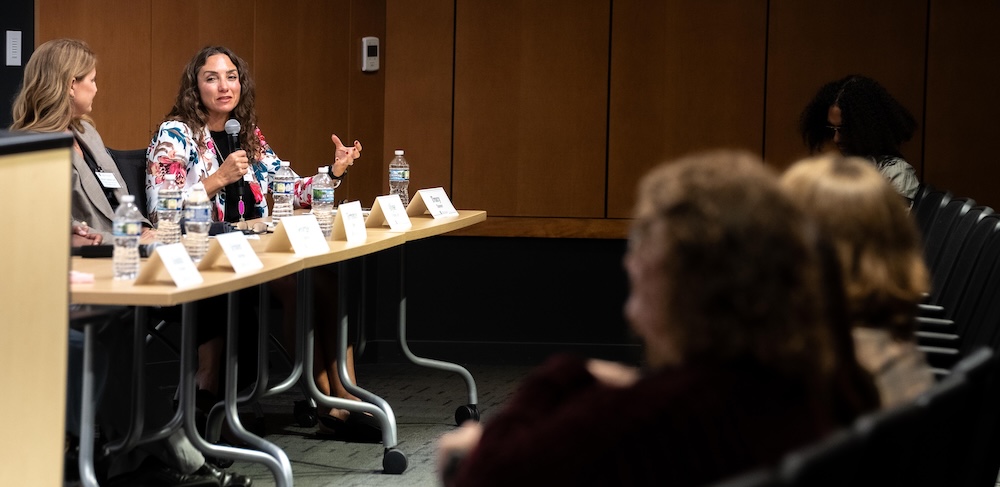
During Mental Illness Awareness Week in October, individuals with lived experience, family members, mental health professionals, students, researchers, and community advocates came together to talk about the future of mental health.
“Mental health research has enormous value to individuals and societies, but only when we’re asking the right questions,” said Katy Thakkar, Associate Professor of Psychology and Director of MSU’s Mental Health Research Connect. “Asking the right questions requires knowledge of experience."
Hosted by Mental Health Research Connect and NAMI Lansing, and sponsored by the Gerson Family Mental Health Initiative, the event strove to strengthen relationships between academic researchers and people who are most directly affected by mental illness in order to maximize the relevance, impact, and reach of mental health research.
“I’m so grateful for the opportunity to co-organize tonight’s event with the Lansing chapter of NAMI. This is our third year co-organizing this event together and seeing this kind of turn out tonight, to me, really attests to the power of academic-community partnerships but more so to the impact of NAMI in the community,” said Thakkar. “I would also like to extend a huge thank you to Barbara and Mark Gerson who created the Gerson Family Mental Health Initiative. For over a decade, their generosity has provided education and care to MSU undergraduates. And their passion for educating people about mental health helped make tonight’s event possible.”
The event featured Thomas Insel, MD, the former Director of the National Institute of Mental Health, who delivered a virtual keynote lecture titled “What Comes Next: Healing, Recovery, and the Future of Mental Health Care.”
Dr. Insel’s recent work focuses on what it takes to support meaningful recovery for people with serious mental illness, including the importance of people, place, and purpose. That focus is at the heart of his book, Healing: Our Path from Mental Illness to Mental Health, which centers on working with community partners to enhance social connection, housing, and opportunities for meaningful participation in people living with mental illness.
“A big takeaway from Dr. Insel’s talk is that a lot of money and time has been spent looking into the biology of serious mental illness, but that if we really want to improve the mental health crisis, we need to start asking the people living with serious mental illness and those who serve them for their expertise on how to improve people’s lives as a whole,” said Morgan Gaston, the project administrator for MSU’s Mental Health Research Connect. “That can help us turn the mental health care system from focusing solely on clinical symptom reduction to quality of life.”
After the talk, a Q&A with local experts and community leaders, including Khadja Erickson from Tenant Resource Center of Michigan, Kristen Harrigan from Northwestern Michigan College, George Hatter from Charter House, Terrence King from Kingdom Ministries, Dr. Alyse Folino Ley from the MSU Department of Psychiatry, and Tracy Tanner from the City of Lansing discussed the future of mental health care and how it can better serve local communities.
Communicating through art
The gathering included an art exhibit featuring artwork from people with lived experience of mental health challenges, family members and caregivers, mental health professionals, students, advocates, and community members whose creative work contributes to this conversation.
“Art can communicate experiences that statistics and clinical language cannot. It can give shape to grief, hope, isolation, connection, identity, recovery, resilience, belonging, and possibility,” said Carrie Lee Edwards from NAMI Lansing. “It can help us see ourselves in another person's experience—and remind us that mental health is not simply a medical issue, but part of the human experience.
The artwo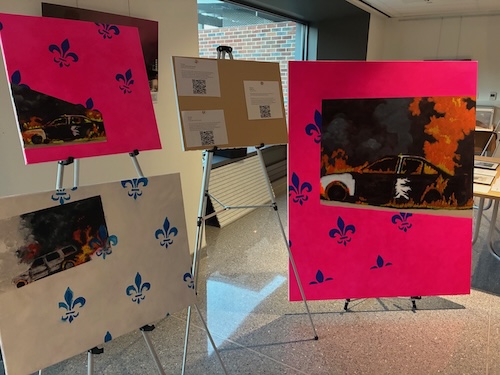 rk explores themes of mental health, healing recovery, resilience, community, belonging, purpose, or visions of what comes next.
Lansing artist Tim Lane included three paintings from his “The Burning Car’ series. They depict the internal experience of recovery. Lane’s work has been exhibited locally as well as in Detroit, Chicago, Minneapolis, Cincinnati and Washington, D.C. Tim is also a published poet and novelist.
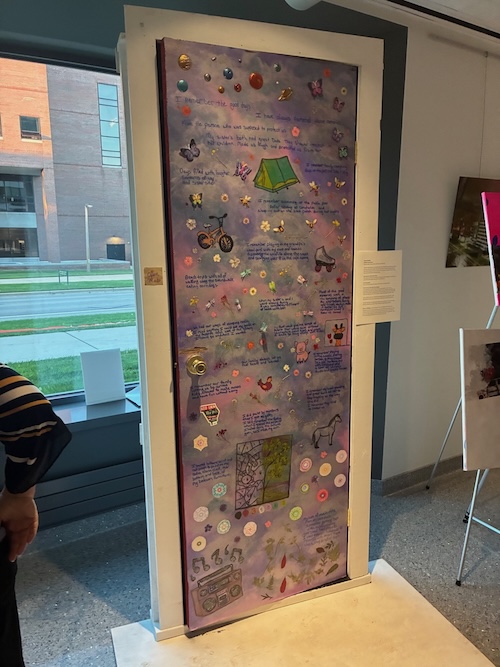
Susan DuBay’s “Behind Closed Doors’ was also on display. This installation explores the chasm between public persona and private reality. The piece consists of painted doors with images on the outside representing a “perfect” childhood and young adulthood. Opening the door, however, reveals the ‘raw, unvarnished truths’ that had been kept out of sight. DuBay lives in Howard City, Michigan, and exhibited at ArtPrize earlier this year.
Megan Riley, a psychology major and Social Science Scholar, helped organize this portion of the event. As someone who is interested in understanding lived experiences and highlighting the realities of life beyond a diagnosis, she found the artwork provided meaningfully to the themes of the night.
“The inclusion of artwork added another dimension to these conversations by providing a powerful medium through which individuals could express experiences that may be difficult to capture through traditional discussion alone,” said Riley. “Mental health conditions and situations are incredibly personal, complex, and dynamic so to see how the art sparked new conversations among community members was inspiring.”