What voices aren’t being heard in research?
If you’ve worked with Dr. Kaston Anderson Jr., you have likely heard this question. Anderson, an associate professor of psychology, focuses on communities that do not have adequate access to services and who are often excluded socially, economically or politically. This could include, for example, a rural community where the nearest hospital might be 50 miles away. If a person doesn’t have adequate transportation, they may not be able to get medical or mental health services.
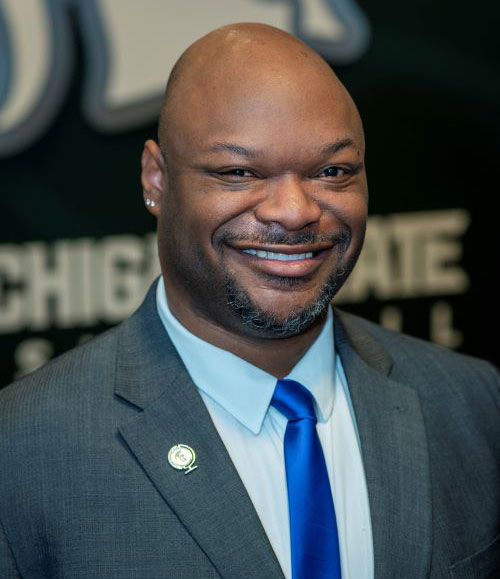
“These individuals deserve to have their voices heard in research and the scientific community as well,” Anderson says. “I’m a firm believer that everyone is an expert in their own lived experience.”
As a behavioral psychologist, Anderson studies social determinants of health—or in other words, the conditions that we’re born into, what we grew up in, that we live and work in. This also includes social norms, laws, and policies that can influence the neighborhoods and conditions that we live in.
Having grown up in a very rural part of Louisiana, Anderson saw firsthand how communities are getting missed. This has fueled his work as a researcher.
Pollution, injustices, and health in rural Louisiana
One major project of Anderson is scientifically studying the impact of air pollution and social determinants of health on cognitive well-being and quality of life for older Black Americans in rural Louisiana. Thanks to funding from MSU’s Tetrad Initiative for Interdisciplinary Research, he is conducting this research with Dr. Norman Scheel (Department of Radiology) and Dr. Masako Morishita (Department of Family Medicine).
This stretch of Southeast Louisiana has long been known as Cancer Alley. Many residents in this area have been diagnosed with cancer at a significantly higher rate compared to other geographic areas. Black American residents also deal with the added toll of historical segregation and other social inequities.
The team of researchers will use cognitive, behavioral, and environmental assessments to measure cognitive decline, behavioral risk and protective factors, toxic metal data, water toxicity levels, and indoor air quality. Physiological measures of blood oxygen saturation will be used as well. Qualitative interviews will be conducted with 60 participants to examine the lived experiences of older adults living in air-polluted environments.
Alzheimer's disease risk in rural Michigan
Thanks to a grant from the Michigan Alzheimer’s Disease Research Center, Anderson is also studying the impact of social determinants of health on Alzheimer’s disease risk in Michigan.
His team will be examining different trajectories for people across racial/ethnic backgrounds, income levels, education attainment, and location. He will look to see how those things together and separately impact people living with Alzheimer’s disease. In addition, his team will study how other factors, including social determinants of health, COVID-related healthcare, discrimination, and social relationships affect mental health conditions in people living with Alzheimer’s disease.
“I’m fortunate to have received funding to study both of these projects,” said Anderson. “Being able to study social detriments in two different geographic contexts will help tell a more comprehensive story of how these non-medical factors affect health and well-being.”
Belief in the citizen scientist
As a firm believer in the citizen scientist, Anderson and his lab works to empower community members to collect data themselves and be able to draw conclusions based on the data that they collect.
“Historically, researchers would parachute into and out of marginalized communities, which would make them feel even more exploited. My lab and I work with communities, not just in communities,” said Anderson. “When I work with communities, even the 85-year-old grandmother learns how to look at charts and tables and draw conclusions on the data.”
Working with communities allows for community buy-in, which is critical for successful community intervention, added Anderson.
“Science is for the people,” said Anderson. “If we’re doing research and no one in the community believes it to reflect their lived experience, then we need to reevaluate what we’re doing and why we’re doing it.”