Psychological evaluations can cost thousands of dollars in the United States—a cost that many people seeking asylum cannot afford.
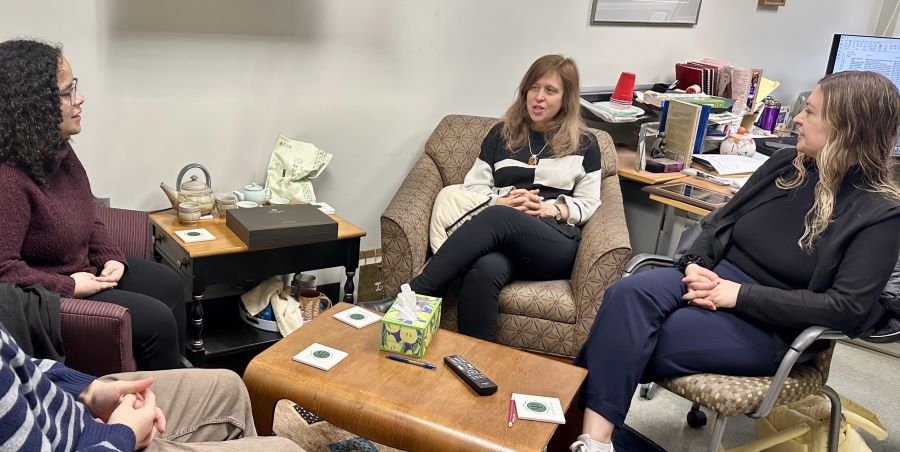
To help address this need, clinical science graduate students in the Department of Psychology have partnered with the MSU Immigration Law clinic to provide psychological evaluations for free.
“We’ve learned that there is a backlog of over 3 million immigration cases,” said Alytia Levendosky, PhD, Professor and Director of Clinical Training at MSU. “By creating this partnership to offer pro bono psych evaluations, we’re hoping to make a difference in the lives of our community.”
Psychological evaluations can be particularly helpful in immigration cases. They provide evidence of a person's mental health –including whether they have experienced trauma and have mental health effects from trauma. These evaluations can be used to demonstrate the need for asylum protection in court.
Since last summer, Dr. Levendosky and a team of student clinicians have completed seven psychological evaluations for clients of the MSU Immigration Law Clinic.
Addressing structural barriers
Graduate student Alexandra Ballinger was the first student clinician to provide a psychological evaluation for a client of the Immigration Law Clinic—and she’s had one other case since then.
Her clients came from Mauritania and Eritrea and were seeking asylum after having been imprisoned and tortured by state actors for their political beliefs and activism. Both of her clients were primarily stressed from being separated from their loved ones and being concerned about their family who are still facing persecution from the governments in their home countries.
Ballinger noted that this work provides a unique experience of addressing the structural barriers that may impact a person’s wellbeing.
“I could be their therapist for six years and only be able to help them cope with having experienced trauma but not be able to change their circumstances, which doesn’t always feel effective,” said Ballinger. “Playing a small role in the process of changing their circumstances (i.e. citizenship in the U.S.) feels very meaningful. So, even though it’s a one-time intervention, our hope is that it can be very impactful.”
A new type of training
Clinical science students at MSU are well trained in a variety of assessments from psychodiagnostic assessments to cognitive assessments for ADHD or autism. These types of assessments often help set the person up for therapy.
But immigration cases have different needs.
This led Levendosky and the team of graduate students to develop a protocol specific to the needs of the immigration courts. Asylees they work with complete several questionnaires as well as a structured interview for establishing various diagnoses of mental health disorders.
“This is a great training opportunity for our students,” said Levendosky. “This is a very different way of making a difference as a psychologist. It also is a powerful way to serve our broader community as part of the mission of a land grant university. It feels very rewarding to make a difference for our community.”
The graduate students also received training last summer about the psychological consequences of being an asylee. They also completed a roughly ten-hour training session through the Physicians for Human Rights, a free course available to psychologists and physicians. Veronica Thronson, Director of the Immigration Law Clinic, also provided training about the legal process.
“Our partnership with the MSU Department of Psychology has been highly beneficial in the legal representation of our clients, including asylum seekers and victims of domestic violence,” said Thronson. “Having an independent professional assess our clients’ traumatic experiences provides additional evidence to present in support of our clients’ claims. This often is the first time our clients speak with a mental health professional.”
Asylum cases and more
Carolina Anaya Maldonado, a fifth-year clinical science student, was expecting that the people she provided psych evaluations for would all be seeking asylum, but that wasn’t the case.
She first completed a psychological evaluation for a single mother from Guatemala who experienced a sexual assault while in the United States. She then worked with a woman who was seeking guardianship for her adult brother from Venezuela. The brother had a disability that prevented him from being able to take care of himself.
“Both cases have taught me more about how systems can impact an individual and their mental health,” said Anaya Maldonado. “It’s also provided a unique opportunity to apply the assessment skills that I learned in the MSU Psychological Clinic to cases in a nontraditional way. It’s been a really positive experience in my training as a clinician.”
The MSU Immigration Law Clinic noted that they are seeing positive results from the evaluations as well.
“In the case where we were seeking guardianship for a severely disabled client, the judge specifically stated how important the psychological testimony was in reaching a favorable decision for our client,” said Thronson.
A unique collaboration
The collaboration between the MSU Psychological Clinic and MSU’s Immigration Law Clinic is unique—even though many universities have both immigration law clinics and clinical psychology doctoral programs.
“This is often the first opportunity for our law students to work with professionals from other fields and learn how valuable interdisciplinary perspectives can be in crafting legal representation,” said Thronson. “Psychological evaluations are generally out of reach for our indigent clients, and I am grateful for this partnership to provide much needed help for our clients seeking safety in this country.”
Levendosky hopes to help establish this collaboration at other universities in the future by showing what they’ve done and sharing their assessment tools.
“This partnership is mutually beneficial for everyone involved—and hopefully most of all for the clients” said Levendosky.