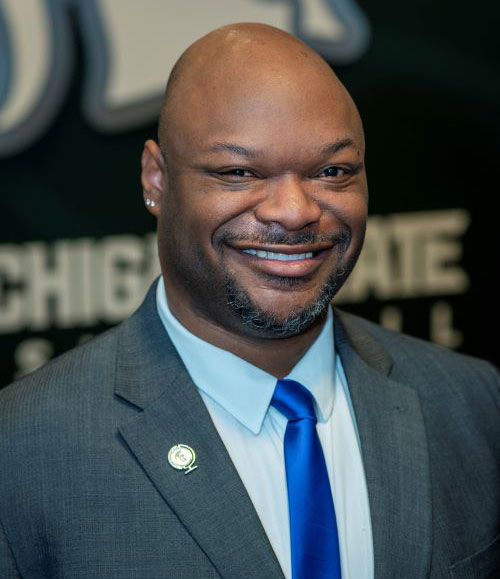
Growing up in a segregated town in rural Louisiana, surrounded by chemical plants and oil refineries on one side and a nuclear power plant across the river, I learned early to ask why. Why do some communities have access to resources while others don't? Why are health outcomes so much worse in the Black section of my hometown? These childhood questions would eventually shape my entire career.
Service was not just an abstract idea in my home—it was a way of life. My mother, a now-retired educator, instilled in my brothers and me the importance of giving back long before I understood what community-engaged research meant. We volunteered regularly with the Special Olympics, and even during seasons when our own resources were limited, we found ways to serve. Many summers were spent delivering food to families across our community. Those early experiences taught me a lesson that still guides my work today: the most precious gift we can give is our time. Serving communities is not charity—it is an act of love.
My path to psychology was unconventional. At 20, as a biochemistry major on a semester break, I picked up my mother's Introduction to Psychology textbook and read it cover to cover. I knew immediately that I wanted to do psychology, even if I didn't know what that would look like yet.
My journey ultimately wound through multiple master's degrees—one in experimental psychology and applied behavior analysis, another in public health—before I earned a PhD in behavioral psychology with a specialization in community health and development. I also completed a postdoctoral fellowship in addiction health services research. This multidisciplinary foundation reflects my core belief that no one discipline has all the answers.
As a Black queer man in academia, often the only Black person or one of few Black men in professional spaces, I believe diverse perspectives and lived experiences are essential to addressing complex social issues. Our collective strength is not in our ideologies, but in our commitment to honoring one another’s personhood and experiences. When we are intentional about creating spaces where everyone’s humanity is welcomed, honored, affirmed, and celebrated, we can create rigorous solutions that are both sustainable and equitable.
In my work studying social determinants of health, I work closely with a lot of local, national, and international communities to avoid doing “parachute research”—the practice of researchers entering communities, gathering data, and leaving without empowering those communities to continue the work themselves. My 24-person research team works with community members to show them how to collect data, analyze results, and draw their own conclusions. Even the 85-year-old grandmother in rural Mississippi can learn how to collect and analyze data. I firmly believe that their lived experience is just as important as my academic training. No textbook, no research article, and no grant proposal can teach the wisdom and knowledge that comes from lived experience.
In the classes that I teach, I don’t give traditional tests only. I also use in-depth case studies based on my own work and experiences. For example, I might require my students to walk me through how they would conduct a comprehensive community assessment to address Type 2 Diabetes in Detroit and Lapeer. Then, I might follow up with questions that require them to develop a multicomponent community intervention with a detailed evaluation plan. I remind students that problem-solving in isolation is obsolete. Modern science requires collaboration, constructive feedback, and evaluating multiple options.
As a researcher and educator, my mission isn’t to teach people what to think, it’s to teach them how to think. That conviction ultimately shaped my decision to write Health Psychology: Multicultural and Global Perspectives. For too long, health psychology has centered individual behavior while treating structural inequities as secondary considerations. The textbook positions health psychology not simply as the study of individual behavior, but as a discipline responsible for confronting the structural conditions that shape our health.
It’s for anyone who wants to see that they, too, have a place and voice in health sciences. The textbook has a core theme: healing—even in a fractured world—is always possible.
If a five-year-old or our 70-year-old grandparents can't understand our research, we as scientists need to reevaluate what we're doing, why, and how we're communicating it. Some researchers work in communities to extract information, publish papers, get grants funded, and leave nothing behind for the communities. My approach is fundamentally different. I work “with” communities to co-create knowledge. I place community authority at the forefront of my work. I publish with community members as co-authors, and I work hard to ensure I always protect their reputation.
Because the purpose of science is clear and uncompromising: science is for the people.
We must be disciplinary polyglots—able to discuss research across disciplines, community sectors, and with the general public.
Looking back, my career has exceeded everything I imagined when I first told myself I wanted to be a professor. My heart is in the community. My passion is working with marginalized and underserved communities across the world and advocating for their experiences and voices to be heard. Being a community-centered health psychologist is just my way of being able to do that.