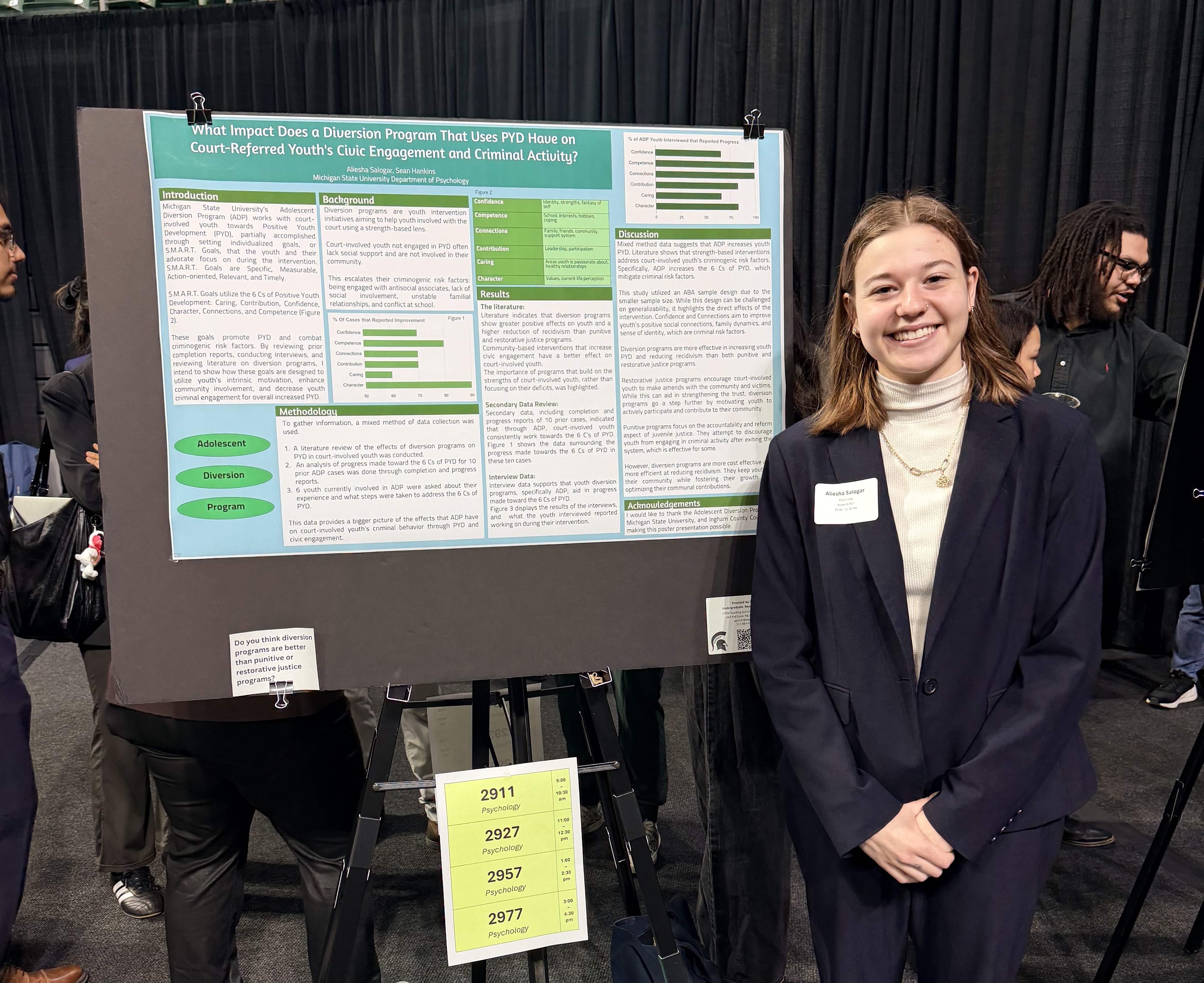
Aliesha Salogar, a senior psychology major and cognitive science minor, experienced the effectiveness of the Adolescent Diversion Program (ADP) firsthand as an MSU student mentor. She wanted to know, though, just how effective the program is on positive youth development. She worked with ADP Director Sean Hankins on a research project doing just that.
Now, Aliesha is working with another ADP alum to analyze where diversion programs in Michigan are located—and who might be getting missed.
Continue reading to see what the research shows—and why Aliesha believes in this program.
What has been your experience with ADP?
I wanted to work more with people in the legal field, so I looked into different programs. I talked to my advisor got referred to this program. After applying and interviewing, I started last fall. We did our first semester of getting to know the program then our second semester of being paired with a kid for 18-week interventions. Ever since that I've been working with the ADP director Sean Hankins on a research project and I’m hoping to be a teaching assistant in the fall.
Tell us about the research project you did on ADP.
I was curious about how ADP influences the six Cs of positive youth development: connections, competence, confidence, character, caring, and contributions. I interviewed kids that are currently in the program, then reviewed some past closed cases and their completion reports. I looked for patterns and analyzed what the youth said they improved on. It was really interesting to see the patterns emerge, and I was able to present my findings at UURAF last spring.
In reviewing the 10 prior cases, the court-involved youth reported progress in character and competence the most but growth in every area. The interviews with current kids in the program showed the most progress in competence, connections, and character. I’m working right now on developing intake questions that are a bit simpler because we found some of the youth didn’t really understand the language around some of the variables we asked about.
Did anything surprise you from doing research on ADP?
It really hit me how wide the age range is for the kids that work with ADP. I had seen it on paper, but it was cool to see in person how different everyone is. For ADP to be able to interact with and to successfully intervene in such a wide range of ages was really cool to see.
Did ADP help you kind of figure out more what you wanted to do career wise?
ADP helped me figure out my path. Previously I had theoretically been interested in working in the legal field, but ADP helped confirm that I do definitely want to work there going forward. By getting hands on experience working with kids and seeing how much of an impact a program like this can have, it really helped solidify that I want to go into this line of work.
ADP is having its 50th anniversary this year. What does it mean to you to be a part of such a longstanding program?
It's really, really awesome. The program is so unique - both in what it does and in the community that it builds. Everybody seems to still be in touch with everybody. When I was talking with Sean about wanting to do research on ADP, he got me in contact with people that did the program 10 years ago...and they’re still in contact. We went to court the other day, and he points out people who went through ADP. Seeing where everybody ended up and how everybody still is in contact with each other, and how close and honest everybody is with each other is really unique. It's been really awesome to be a part of that and to help keep that going.
Are you continuing to do research with ADP?
I'm currently working on a research project with an ADP alum that now works at the University of Michigan. We're looking at the diversion programs in Michigan and how they're divided through the state. We want to know if anyone is getting missed by the diversion programs that are offered because of driving time and location. Right now, we're working on the mapping aspect, and it's been interesting to see how they're distributed. We have to still overlay the drive times, but there definitely are clusters in the more urban areas and are more isolated in the rural areas.
What does it mean to you to be a part of this program?
Working with one kid over the course of 18 weeks and seeing how they were helped and changed through this program really did mean a lot to me. Seeing firsthand how important that kind of work is and seeing that I was capable of doing it was really something. It was really nice to be a part of that and to grow with my classmates as we learn through it. There were a lot of learning curves about how we can help each kid. You think one thing's going to work, and it doesn't work, so it meant a lot to be able to go into class and brainstorm ideas with classmates that then helps your kid. It was really bittersweet at the end because it was a huge time commitment, but I also learned so much about myself and about the field. I'm really glad I got to be a part of it.
What would you say to somebody who's thinking about doing ADP?
If you can commit to the time commitment, you should 100% do it. It's an awesome experience, but you also have to be committed for the sake of the kids involved. If you're willing to do that, 100% do it, because I cannot imagine what I would be doing now if I didn't do the program. It's an incredible experience all around, so I would highly recommend doing it.
I think anybody who is interested in sociology, social work, psychology, the legal system, or any of that, I'd say just go ahead and do ADP. It really solidifies what aspect of it you're the most interested in, and you learn a lot about yourself and how you interact with people and overcome obstacles. You have to do more than you probably thought you ever would, but Sean is a great leader who cares a lot about his students’ success, so he will definitely help you out if you need it. I would highly recommend doing it for anybody who's just curious.