Dr. Brooke Ingersoll, Dr. Katy Thakkar, Dr. Amy Drahota, and Dr. Raffles Cowan are accepting graduate students for Fall 2027.

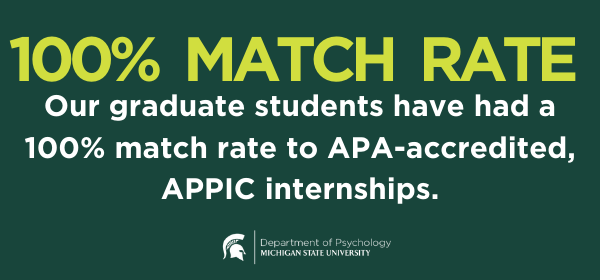
The graduate students in our Clinical Science program are the backbone of the program. The program has 20-25 active graduate students at any one time, and all students are actively involved in research labs, staffing the training clinic, and assisting in course instruction. The quality of our students is evidenced by their high-level of research productivity and their success on the internship and job market, including a 100% match rate to APA-accredited, APPIC internships.
Here, we have a mentorship model that encourages an apprentice-like relationship between our students and advisors. Advisors assist students in conducting cutting-edge research, developing individualized training experiences, and closely guiding them through the program. We also encourage students to work in multiple labs and develop expertise in multiple methodologies that they may apply to their own work.
Our graduate students train in evidence-based assessment and therapy from relational psychodynamic, CBT, and third-wave CBT approaches in our state-of-the-art Psychological Clinic, which boasts a strong relationship with the broader community. Clinical supervisors, including our faculty as well as experienced clinicians in the community, guide and provide feedback and instruction to student clinicians.
We also have a monthly brown bag series for students and faculty to come together and learn from one another. This series illustrates our value of life-long learning and has proven to be a meaningful integration of clinical and research skills.
We are delighted that you are considering applying to MSU's Clinical Science Program!
Indeed, we are proud of our program and hope you will take some time to visit the rest of our website and the links below to obtain more information about our mentorship model, admissions process, curriculum/program requirements, and graduate life at MSU.
If you join our program, you will join an outstanding graduate student body that is actively engaged in all aspects of clinical science. The quality of our students is evidenced by their excellent undergraduate academic records and high-level of research productivity and their success on the internship and job market. Indeed, all of our students are active in presenting at national and international conferences and publishing their research (see Research Output Table on the Current Student page).
Our students also develop clinical excellence during their training, as evidenced by our 100% match rate to American Psychological Association (APA) accredited, APPIC internships for the past 15 years. Our students have matched to highly competitive sites, including programs at the University of Washington, McLean Hospital/Harvard University Medical School, Yale University Medical School, Western Psychiatric Institute and Clinic/University of Pittsburgh Medical School, and Stanford Medical School.
Finally, our students are employed in a range of clinical science positions, including postdoctoral or faculty positions in academic settings and clinic director positions.
Please consider applying if your interests and values in clinical science are a good match with our program. We look forward to considering your application.
Sincerely,
Brooke Ingersoll and Katy Thakkar, Co-Directors of Clinical Training (DCT)
General information about how to apply, including deadlines, components of the application, and admissions procedures can be found on the Graduate Admissions page.
Our Clinical Science Program requires a two-part interview for admission.
After reviewing applications, we will be inviting a select group of top candidates for a first-round virtual interview. These virtual interviews will take place in early January. If you are selected for this stage, you will be contacted with further details regarding scheduling and instructions by mid to late December.
From the first-round interviews, we will invite the most competitive candidates to participate in an in-person interview. Please note that all travel and accommodation expenses for the in-person interview will be covered by the program. We notify candidates who are invited for an in-person interview by mid-January.
Our program is structured so that training in courses, research, and clinical work is intended to be sequential and cumulative, such that students move toward increased independence and sophistication in their work as they progress through the program. The Master’s portion of the program is designed to take two years, while the doctoral program generally takes four years (including the internship). The training model is implemented through (i) core courses, (ii) practicum, (iii) a cognate, (iv) a comprehensive examination, (v) mentored research projects (i.e., master’s thesis and dissertation), and (vi) a clinical internship. You can learn more about our curriculum and program requirements, including clinical practica and internship training, in the Graduate Student Handbook.
Per our APA accreditation, Clinical Science Area graduate students must meet any additional requirements that the State of Michigan has for licensing. Michigan licensing law requires no additional courses, but the program must be accredited. The Clinical Science Program is accredited by APA and PCSAS, so this requirement is automatically met.
Questions related to the program’s accredited status by APA should be directed to:
Commission on Accreditation
750 1st Street NE
Washington, DC 2002
Phone: (202) 336-5979
Web: www.apa.org/ed/accreditation
Questions related to the program’s accredited status by PCSAS should be directed to:
Psychological Clinical Science Accreditation System
1800 Massachusetts Ave NW, Suite 402
Washington, DC 20036-1218
Phone: (301) 455-8046
Consistent with our philosophy of multi-level and cross-disciplinary work, our mentorship model is one in which students have a primary advisor within the Clinical Science Program, but are encouraged to work with a range of faculty in our Clinical Science program as well as related disciplines.
Although the research training is done primarily through an apprenticeship with the primary mentor, the full Clinical Science faculty are actively involved in the overall student training through coursework, clinical practica, evaluation of students, and intellectual activities (e.g., colloquia series and the grant writing seminar). Thus, students are exposed to the multiple perspectives, training, and expertise of the full Clinical Science faculty. We believe that this mentorship model facilitates flexibility in methods and theory, provides the best approach for fostering positive mentor-mentee relationships, and develops research scientists who have a breadth and depth of training in the clinical science field.
In addition to working with a primary, Clinical Science faculty mentor, many of our graduate students have secondary mentors or thesis committee members from outside of the Clinical Science Program. These secondary mentors come from a variety of disciplines and programs including Ecological/Community Psychology, Social/Personality Psychology, Organizational Psychology, Cognitive Science, and Behavioral Neuroscience. These multidisciplinary collaborations are an explicit expression of our clinical science orientation and focus on multi-level work, as our faculty recognize the need for interdisciplinary collaborations in order to conduct state-of-the-science research and remain competitive for top journals and extramural grant funding (see Principles and Values). Graduate students choose secondary research mentors and committee members in collaboration with their primary mentor based upon fit with the student’s research topic and need for additional training/expertise in diverse areas of science.
Upon admission, each student is guaranteed four years of funding (i.e., a stipend, tuition reimbursement, and insurance coverage) from the department via teaching assistantships (TA) and research assistantships (RA). Summer funding and funding after the 4th year are not guaranteed, though most of our students have been supported through RA and TA opportunities. In addition, some of our students have been funded through competitive, university-wide fellowships that provide incoming students with 1 or 2 years of financial support to engage in their own independent research rather than serve as a TA or RA.
Our program, department, and university also provide additional monetary support for and recognition of graduate student clinical research and activities, including clinical work and dissertation research, through various awards and fellowships. The Department of Psychology and College of Social Science additionally provide funding for conferences through travel awards and conference travel grants.
Finally, several of our graduate students have successfully secured multi-year, individual training grants from the NIMH, National Science Foundation, Autism Speaks, and the Canadian Health Institute for Research. Our students have been highly successful at obtaining other external grant support through Blue Cross/Blue Shield, the American Psychological Association (APA), the Association for Psychological Science (APS), the American Psychological Foundation (APF), and other non-profit organizations.
Federal regulations require MSU to publicly disclose, for each educational program designed to meet the educational requirements for a specific professional license or certification required for employment in an occupation (or advertised as meeting those requirements), information about whether program completion would meet those requirements in a state. These public disclosure requirements apply to all programs, regardless of their modality (i.e., on-ground, online, and hybrid programs). MSU discloses the required information for its Clinical Science Program on pages 80-81 of the table at this link.
All current and prospective students are encouraged to contact the applicable professional licensure/certification boards in their respective states for additional information regarding professional licensure/certification requirements, including, without limitation, information regarding any non-educational requirements (such as post-doctoral supervision, licensing examination).
The information in the table should not be construed as guaranteeing that any particular professional licensure/certification authority will approve a student’s application; nor should the information in the table be read to imply that other requirements for professional licensure/certification do not exist or that other requirements for professional licensure/certification have been determined to have been met by MSU’s program/course, or that any necessary approvals for clinical or other experiential learning placements are secured by virtue of a student’s enrollment at MSU.
State professional licensure/certification requirements are subject to change at any time.