

PSY Student Research Spotlight with Peyton McLaughlin
June 1, 2026 - Shelly DeJong
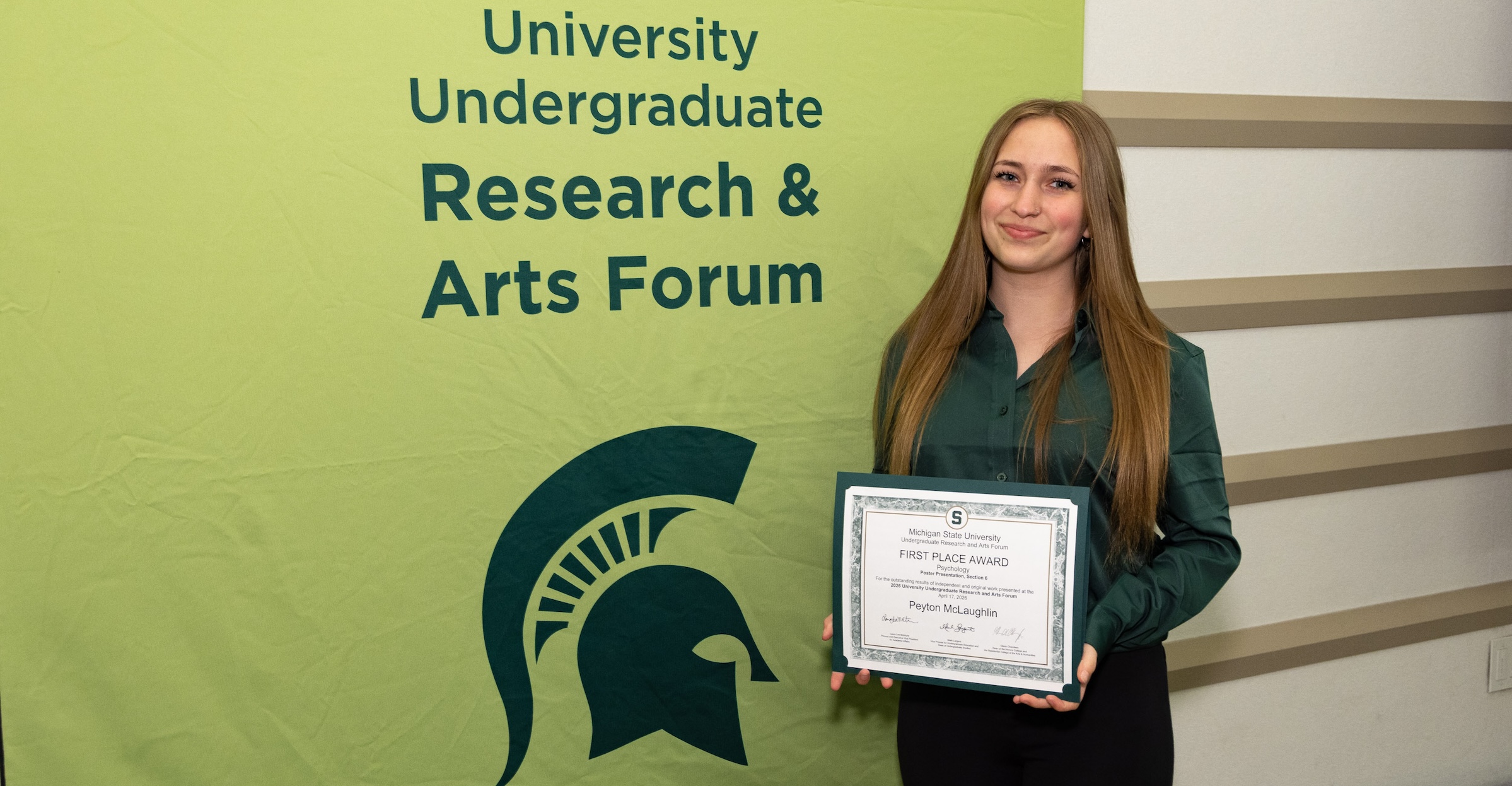
Peyton McLaughlin, a psychology and criminal justice double major, has been working in the Belief Systems Lab with Dr. Mark Brandt for three semesters. This year, her team earned a first-place award at UURAF for their research project, “To What Extent Does Your Social Group (Or ‘Close Others’) Agree or Disagree with Your Political Views?”
Continue reading to get to know Peyton and learn more about her research.
How did you end up double majoring in psychology and criminal justice?
Psychology gives me a lot of clarity on things like relationships, behavior, and how you treat other people. It helps me understand just people more as a whole. I also like how it goes with everything. I’ve found it pairs really well with criminal justice. I grew up watching crime shows with my mom, so I’ve always known I wanted to study behavior, especially criminal behavior.
How did you start working in the Belief Systems Lab?
I was doing research on different psychology labs when I stumbled upon the Belief Systems Lab. It seemed really interesting to me since people have all different kinds of beliefs whether they are aware of them or not. I thought it would be really applicable to my life and the people around me, so I ended up emailing Dr. Brandt to see if I could work with him.
Congratulations on your first-place prize. Tell us about your project.
My teammates, Nicole Thomas and Genevive Orlewicz, and I worked on two projects for UURAF this year, and we were happy to receive a first-place prize!
Last year, Nicole and I had worked with PhD student Shree Vallabha for her dissertation on socio economic downward mobility. We found that really interesting and it led us to ask questions about political parties and how they affect relationships and behavior in general. We worked with Dr. Brandt and used questions from past research to design a survey for MSU students to help us answer our research questions.
In our project on the extent people agree with their social groups and close others, we asked people about the political views of people important to them. Then we tested how similar these beliefs were to their own. We went into the project with the hypothesis that Republicans would view themselves as overall more in agreement with their family than Democrats. But our research actually showed that Democrats viewed themselves as more in agreement with their family ties.
Our other project looked to see if people whose friends and families had more diverse political views, if they were more or less closed-minded. We asked people their perceived similarity with each person, like we did in our first project. Then we asked them questions about dogmatism and moral humility. This measures how close minded you are, essentially. We found that people with more diverse beliefs in their social groups were also less closed-minded. They were less dogmatic and more morally humble.
What is one takeaway that you would want people to know about your research?
One takeaway is to be open to relationships with people different than you. Relationships with people similar to you are very important, but so are relationships with people who you perceive to be in your out group. They're very important for understanding yourself and the people around you.
What has surprised you about doing psychology research?
Before joining this lab, I never realized how diverse psychology research can be. Even at UURAF this year, there were so many psychology posters that were completely separate from what I’m doing. It really showed me that there are endless possibilities of things you can research and that opened up a lot of new possibilities for me. I know now that I want to pursue research in the future through a master’s or PhD program and that’s all because I got involved in this lab.
Would you like to give a shout out to anybody who's kind of helped you in either just your time at MSU or your kind of research journey?
I would definitely say my research partners, Nicole Thomas and Genevive Orlewic, Dr. Mark Brandt, and Abby Cassario, the PhD student who primarily helped us with this project. Also a shoutout to Kenya Mulwa, the other PhD student in the lab. We could not have figured out the coding without him.
Do you have any advice for students who are thinking about getting into psychology research?
Definitely give it a try. Reach out to professors and talk with your peers to see if they know of any opportunities. Definitely use your connections.