

Noelle Martin receives graduate student research grant from the Department of Psychology
December 19, 2025 - Shelly DeJong
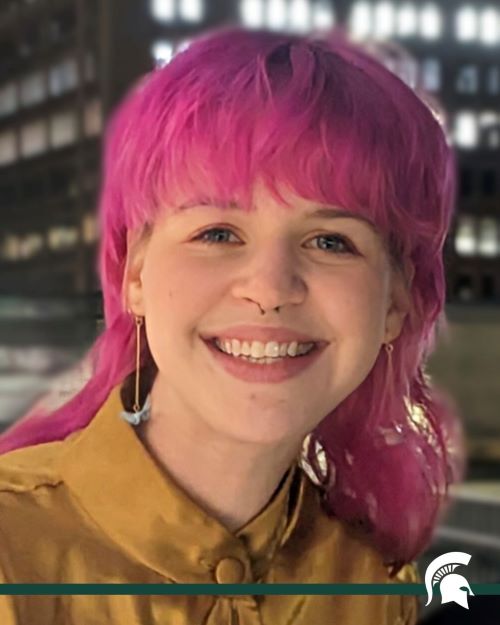 Noelle Martin, a 2nd year doctoral student in the Ecological-Community Psychology research area, received the 2025 Graduate Student Access, Opportunity, and Excellence Research Grant. This grant seeks to encourage and support the department’s graduate students’ exemplary research on topics that examine or advance access, opportunity, and excellence. Noelle recently shared about their work exploring sibling relationships between transgender and cisgender siblings, why this work is important to them, and what this grant will allow them to do.
Congratulations on the grant! Can you tell us about the research project that this grant will be impacting?
This grant will help fund my master’s thesis project where I’ll be doing original data collection through a series of modified focus groups with youth. I'm exploring the sibling relationship between transgender and cisgender siblings and looking at how cisgender siblings can be a form of social support within the family unit for trans siblings. There's not a lot known about that dynamic, so I'm leading focus groups in a very exploratory way to see how siblings can play different roles within different family contexts. I'm going to have a series of focus groups with transgender siblings and then some with cisgender siblings separately to get both perspectives.
What does it mean to you to receive this grant?
I am very, very grateful to have received this grant. It will allow me to pay my focus group participants. One of my core values as a community psychologist is valuing the time and expertise of the individuals who participate in my research, this is especially vital when working with members of trans and nonbinary communities, who have been historically (and presently!) exploited by researchers. Valuing the expertise of participants is even more important within the context of these focus groups, since the participants will also be involved with doing part of the data analysis of their own experiences.
Can you explain how the participants will be participating in the data analysis?
It’s actually a methodology developed by Dr. Sarah Stacy, formerly from Dr. Ignacio Acevedos’ team, a few years ago called Youth Go where participants are involved in the first level of data analysis. It is framed as a game so it’s very friendly for youth participants. The process starts out looking like a standard focus group where participants will write their answers on virtual sticky notes that we will go through and discuss. We then will play a game where they learn some basic qualitative data analysis skills. That prepares them to then go back through their answers and sort them into categories. As a group, we’ll then look across all the responses and discuss what the big takeaways are for everybody.
It’s a really cool way to give participants a chance to correct or explain their responses in the moment. Afterwards, I’ll take everything and do data analysis across groups.
How did you end up wanting to research this topic?
I'm really interested in factors that support positive development for trans youth. I was looking into different forms of social support, and I realized there's a glaring gap in talking about peer support and family support more broadly. Personally, I have two siblings, and I know how big an impact they had on me while growing up. Sibling relationships are some of the longest relationships that people have in their lifetimes and can make a huge difference in someone’s experiences. I was intrigued by this potentially understudied source of social support and wanted to explore more.
Why is it important to you to do this work?
My research interest in positive development for trans youth has in part arisen from my own experiences of being nonbinary. I think it is vitally important that trans and nonbinary researchers are involved in the research of these communities, and that this research is community-based whenever possible. Right now, we especially need more research what factors best support the positive development of trans and nonbinary young people. There is currently a lack of resources for cisgender siblings on how best to support their trans siblings, and I believe this study can inform the creation of a resource so that those close to trans and nonbinary youth can be better prepared to provide support.
Would you like to give a shout out to anyone that has helped you in your PhD journey?
For this particular project, I would like to give a big shout out to Mihael MacBeth who is helping me facilitate the focus groups. They are in their third year in the Ecological-Community Psychology research area and I'm really grateful to them for helping me with this endeavor.
Another big shout out is to my girlfriend. I have been so stressed about this semester, and she has really supported me through it all by doing things like making me dinner, listening to me explain my research, or reminding me to take a break.
Do you have anything else that you want to add?
I'm very, very grateful to have received this grant. It's going to allow me to pay so many participants.