

PSY Student Researcher Spotlight with Aesha Zakaria
January 26, 2026 - Shelly DeJong
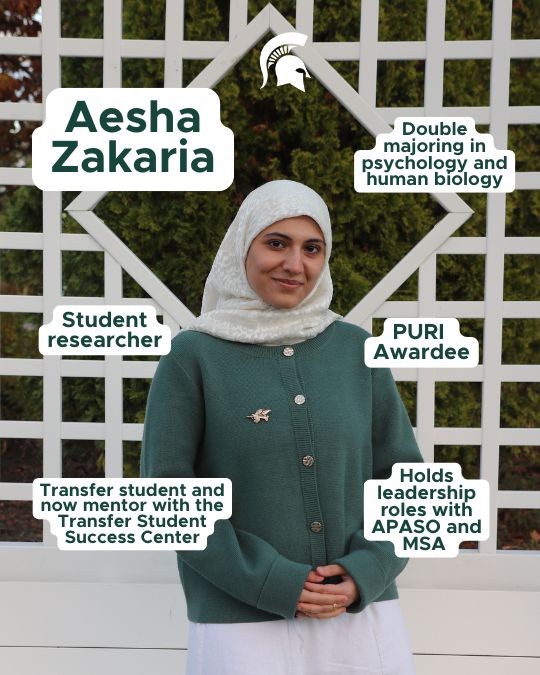 Aesha Zakaria, a senior double majoring in psychology and human biology, has been a student researcher with Dr. Alytia Levendosky's Prenatal Stress Study for a year and a half. Recently, Aesha received a Provost’s Undergraduate Research Initiative (PURI) Award which allows her to continue working on the research project she initiated earlier this year that focuses on the healthcare experiences of postpartum women from their pregnancy all the way to their delivery in Iraq.
What drew you to psychology?
What draws me to psychology is how much everything affects everyone! There are so many things that affect us as people, as communities, as individuals. Our experience with different overlapping things affects our very perception and thoughts as humans and everything that makes us who we are. The human psyche is endless and so intricately inter-woven from different factors-- characteristics that fascinate me endlessly!
Can you tell me about the research that you’ll be doing for your PURI project?
With my recent selection for the PURI Awards, I will be using these funds to support my current research focused on health disparities among postpartum women in Iraq. I got the idea for this research project two summers ago when I went to Iraq to visit family and decided to use my time there to shadow in the local hospitals and clinics there. When I came back to the US after that summer, I spoke with my lab's advisor, Dr. Alytia Levendosky and told her about my idea and she was incredibly supportive from the get-go. Under her supervision, I built the basis of my qualitative research project which focuses on the healthcare experiences of postpartum women from their pregnancy all the way to their delivery. In the 1970s, Iraq had universal healthcare for all of its citizens and residents and was one of the most advanced systems in the Middle East at the time. Now, Iraq's healthcare system is going through very rapid privatization and has reached almost 50% with health disparities running rampant (WHO, 2021). Studying the effects of such a changing system, especially with a focus on a demographic group (women) that is typically first to feel the impacts from these changes, give us a lot of insight about the health outcomes from privatization in healthcare systems.
Why is this research topic important to you?
This topic hits really close to home for me. A lot of the privatization that has taken place in Iraq is due to the destruction of health care infrastructure incurred during the past couple decades of geopolitical instability. Especially in Ninevah, the Iraq governate I am originally from, which suffered a major ISIS occupation from 2014-2017, where some of the biggest hospitals in the region were destroyed during that time. Even after the liberation of my home city from ISIS, there is a lack of health care capacity to fully accommodate the needs of the people. My extended family members who live there might not have been caught in the crossfire during the military fight to reclaim back the city, but they were victims of lack of access to adequate healthcare during those difficult times, especially since several of them suffered chronic illnesses. It is for this reason that the private healthcare sector grew rapidly, but even then, how accessible and affordable is it? What are the disparities present in different populations when they seek healthcare? What are their healthcare experiences and health outcomes? There are so many questions to ask and areas to investigate.
I find that there is a lack of literature on this specific topic. The literature that is there lacks the critical context and knowledge of the history of the population researchers work with. I feel very passionately about this research project, not only because it is directly tied to the experiences of my home community and family, but because there is a huge gap in literature on this topic, which I believe, if we can better investigate and address the health care disparities and weakness in healthcare systems, the better equipped we are to creating stronger resilient healthcare systems—in the Middle East, in the United States, and across the world!
What has surprised you about doing psychology research?
During this process, I have learned so much! Coming into college, my perception of research was largely confined to lab rooms and people in white coats working with Bunsen burners and petri dishes. Becoming involved in the Prenatal Stress Study lab was the first step to seeing the direct application of psychology research-- of which there are so many diverse categories and certainly way more than I ever thought existed. This experience has taught me how much I enjoy directly communicating and working with people in doing research, and I aspire to do more research projects that have strong direct interactions with the participants. I highly recommend that all psychology students work in a lab, even for a short while, and try their hand at research. I never saw myself as a "research type person," but I have clearly disproved that to myself. If anything, I wish I had tried this sooner!
 How else are you involved at MSU?
Ever since coming to MSU, I have always been super passionate about advocacy. Currently, I hold the positions for the co-advocacy chair and ASMSU representative for the Asian Pacific American Student Organization (APASO) as well as the Vice President of Internal Affairs for the Muslim Student Association (MSA). I enjoy these leadership roles a lot, especially because I can have a more direct impact on the respective communities through these positions and responsibilities. I am also a TEMPO mentor for the Transfer Student Success Center (TSSC) where I mentor new and incoming MSU transfer students. As a transfer student myself, this is a role that I care a lot about because I remember the difficulties I had in transitioning to such a big school. I have met and worked with so many transfer students through it and I am so grateful for all the experiences and students I mentored during this time!
Who has helped you along your journey at MSU?
I have many people I want to shout out, but the first on the list is to Dr. Alytia Levendosky, my PI, who has continuously supported me throughout my research project and helped me grow so much as a student and person! I would also like to shout out Dr. Blhum and Dr. Bazgir, my philosophy and organic chemistry professors, respectively. Their support was critical for me at a time when I was having a lot of hesitancies and doubts about my academic and professional path. They taught me to believe in myself-- even when I fail or make a mistake :)
Last but most certainly not least, I give my biggest shoutout to my parents. I am so incredibly lucky and grateful to have parents who believe in me when I can't do it myself and support me in everything that I do. When I was in the midst of data collection this past summer, they were there with me every step of the way, often times caring about my project more than I did myself. I absolutely would not be able to do what I did without their support and care and encouragement throughout the entire process.
What are your plans for the future?
After graduating, I plant to go home to visit my family in Iraq as a vacation and celebration of that milestone! I hope to do some more research during my gap year before applying to medical school programs! All of which I am super stoked to do. :)
Favorite MSU memory?
I have so many fun and closely-held memories at MSU which range from my first NSO where I made my first MSU friends, to working as part of NSO that following year, attending my first APASO annual Cultural Vogue, NAISO's Powwoww, joining case competitions with my friends in Broad College, and all the way to attending the historic ribbon-cutting ceremony of the MCC last Spring! I have certainly had a rich experience in my past years at MSU, and I am so grateful for that.
If I had to pick just one favorite memory, it would be organizing MSA's 2025 World Hijab Day last spring. The process for drafting, planning, and putting together this event meant a lot for me as a Muslim woman who practices the hijab and is often faced with situations with people uneducated about the reason why I wear it and what it means. The event garnered a lot of attendees, some of which were non-Muslims. Being able to provide a safe and celebratory space for my fellow Muslim women on campus was wonderful on its own, but I was so happy when I realized how many people were educated about the hijab because of that event. I hope to assist with this annual event for the spring of 2026, and I hope even more people can come!