

PSY Student Researcher Spotlight with Ronan Scott
February 9, 2026 - Shelly DeJong
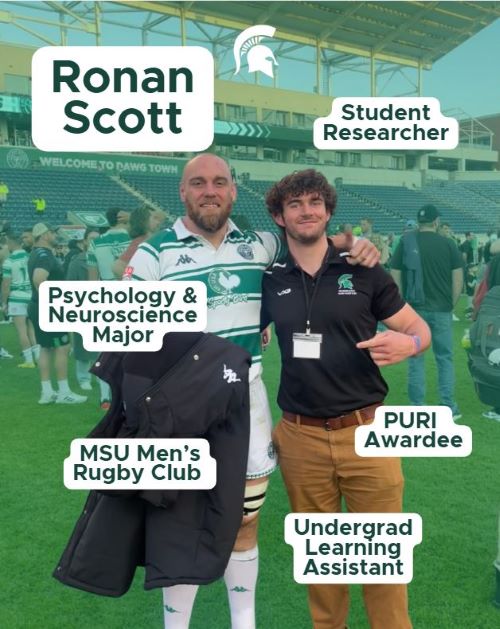 Ronan Scott, a senior double majoring in psychology and neuroscience, has worked as a research assistant in Dr. Kelly Klump’s Hormones and Behavior lab for nearly 2 years. There, he has been able to explore his research interest in understanding the biological and developmental factors that contribute to disordered eating.
Recently, Ronan received a Provost’s Undergraduate Research Initiative (PURI) Award to support his research training and independent project exploring comparative effects of body mass index and body fat percentage on disordered eating symptoms in adolescent boys and girls.
As a student, Ronan is balancing many responsibilities – including playing for and advising the MSU Men’s Rugby Club, serving as an Undergraduate Learning Assistant for Psych 280, and working as a Help Room Aid in the Department of Radiology. As he strives towards applying to medical school in his future, Ronan also works as a Direct Support Professional with Origami Rehabilitation and plans to become EMT certified.
Continue reading to learn more about Ronan, his research, and what advice he has for other students.
What drew you to psychology?
When coming to MSU, I was interested in psychology because I wanted to learn more about the motivations and mechanisms behind how people behave. I love being a psychology major because I feel it provides an extremely broad skill set that I can use in everything I'm involved in. It allows me to better interact with people and understand how to work better with others in all settings.
My psychology coursework piqued my interest in learning more about psychological science, so I joined the Klump Lab as a volunteer research assistant in January 2024 to gain more hands-on research experience. Through my involvement in the lab, I have been fortunate to serve as a research assistant on two NIMH-funded studies examining gonadal hormone effects on mental health outcomes. The first study was focused on examining adolescent male twins during puberty and the second study is examining women during midlife and the menopause transition. Both of these populations are vastly underrepresented in eating disorder research, so I feel that there is a need to find out how risk for psychological difficulties, like disordered eating, may become heightened during these phases of life and how experiencing these symptoms can impact individuals’ overall functioning and well-being.
Tell us about your PURI project.
The research I am conducting is focused on gaining a better understanding of associations between body composition and disordered eating symptoms in adolescents. Specifically, I am examining the differences in the association between Body Mass Index (BMI) and body fat percentage and disordered eating symptoms across age and sex.
BMI is a robust predictor of disordered eating symptoms in adolescence and is linked to the subsequent development of eating disorders. However, it remains unclear whether BMI is the most relevant marker of body size and composition for disordered eating risk. Although BMI is widely used as an anthropometric indicator, it is an imprecise measure of body composition since it indexes overall body size without distinguishing fat and lean mass. Body fat percentage provides a more specific index of body composition and may therefore be more predictive of disordered eating risk, but it is resource-intensive to collect and rarely examined. In an effort to clarify the role of BMI versus body fat percentage in disordered eating, I will examine their overlapping and distinct associations with disordered eating symptoms in adolescent boys and girls.
What has surprised you about doing psychology research?
What surprised me about psychology research was how much time and effort truly goes into each step of the research process. The number of times that I created syntax and ran a test, only to realize adjustments were needed before rerunning the analysis is astounding. The process has underscored how much research involves continual learning and careful review and how valuable it is to have mentorship throughout the process. Another part that I was surprised about was how much back-and-forth discussion there is with others who have experience in the field. Research truly is a collaborative effort, even with those who aren't working on the same project.
 How else are you involved at MSU?
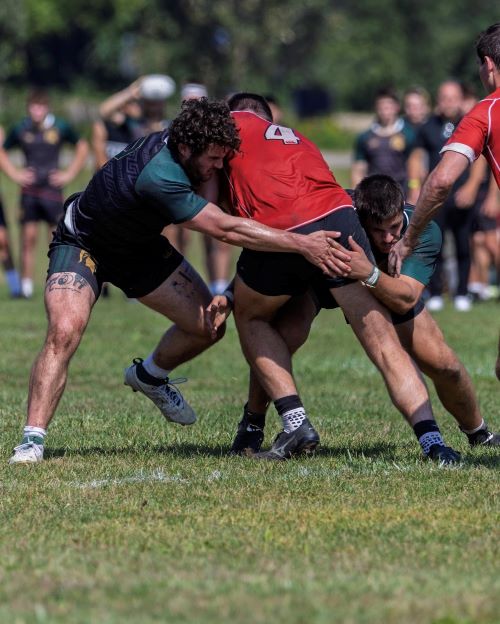
In addition to my involvement in the Klump Lab, I am involved in multiple other clubs and activities at MSU. I have been on the MSU Men's Rugby Club all my years at MSU; I was formerly the president of the club and am currently in an advisory position to the current E-Board of the team. I have been playing since high school, so I have been in the sport for about 9 years now.
Additionally, I have been committed to helping other students reach their academic goals and deepen their understanding of course material. I serve as a ULA for PSY 280: Abnormal Psychology in the Department of Psychology, and I work as a Help Room Aide for ANTR 350 in the Department of Radiology. I also work as an independent tutor for students taking ANTR 350 and PSL 250.
Who has helped you along your journey at MSU?
Some of the faculty who have helped me most throughout my journey at MSU have been Drs. Kristen Culbert, Kelly Klump, Ryan Tubbs, and Kandy Patrick McKeown. I would also like to give a shoutout to Angela Michael and Alex Dailey, who work in MSU’s Recreational Sports and Fitness Services. They both have been great to work with and have helped with guiding my journey to where I am today, both professionally and personally.
What are your plans for the future?
In my future, I plan to attend medical school. During my time until then, I am continuing to work as a Direct Support Professional for Origami Rehabilitation. Down the line, my goal is to earn my EMT certification to gain more clinical experience. I currently plan on applying to medical school to begin a program in the Fall of 2027.
Advice for other students?
Don't be afraid to take chances and commit to new experiences! I wouldn't have the experiences and knowledge that I have today without taking a chance every once in a while. By trying something new, you can figure out what you're passionate about. You’ll find much more satisfaction if you do things that you care about.
Mostly importantly, take care of yourself and have grace with others. You may not know what you're doing every once in a while, and everyone else is probably in that same boat. So, be kind and have grace.