

PSY Graduate Voice: What it means to be a Spartan
May 26, 2026 - Anastassiya Kan
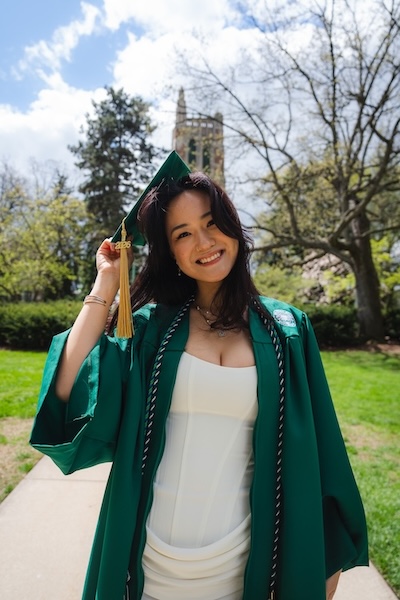 Anastassiya Kan is a '26 MSU graduate with a degree in psychology. Here, she shares about adjusting as an international student, fighting her way back after numerous health challenges, and staying connected to MSU through it all. Her story shows the resilience and determination which is at the heart of Spartans Will.
In 2022, I arrived at Michigan State University as an international student from Kazakhstan, ready to begin my bachelor’s degree journey and pursue my American dream. I came to MSU full of hope, excited to build a future in a new country, make friends, and move toward my dream of becoming a therapist.
But almost immediately, I realized how unprepared I was for what it actually meant to start over in a place so far from home. I had never been to the United States before, and everything felt unfamiliar at once: the culture, the environment, the social norms, and the pressure of trying to find where I belonged. My first semester was a difficult adjustment. I watched other people seem to build friendships so naturally, while I often felt like an outsider. I spent much of that time in my dorm room, hoping things would eventually get easier.
Even then, I fell in love with MSU. There was something about the energy of this place, the sense of community, and the Spartan spirit that made me feel connected to something bigger than myself.
Then February 13 happened.
Like many people in this community, I was deeply affected. In the days that followed, when many students went home to be with their families and loved ones, I stayed on campus, overwhelmed by shock, grief, and the constant stream of news surrounding the tragedy. Not long after, my mental health deteriorated so severely that I had to leave early in the semester and finish my classes from home.
I was diagnosed with severe reactive depression, and what followed was one of the hardest periods of my life. There was a painful irony in it: I had come to college wanting to one day support people struggling with mental health, yet I found myself living through the very things I had read about in textbooks while still feeling hopeless. Recovery was slow. There were months when simply getting through the day took all the energy I had. My family urged me to stay closer to home, transfer schools, or step away from college altogether so I could focus on healing.
But I could not let go of MSU.
Even at my lowest point, I knew I wanted to come back and finish what I had started here. By then, I felt like I was already a Spartan, and giving up on MSU would have felt like giving up on a part of myself.
When I came back to campus, I connected with Counseling and Psychiatric Services right away and began my second year. That year was incredibly difficult. There were days when getting out of bed felt impossible. At that point in my life, recovery itself had become a full-time commitment. I did not have the energy to join clubs, get involved on campus, or build the kind of college life I had once imagined for myself. My focus had become much more basic: stay alive, keep going, and do my best to keep up with school.
Looking back, one of the things I hold closest to my heart is the support that surrounded me. Whether it was CAPS, my friends at MSU, my loved ones back home, or my family checking in from afar, I was carried by people who refused to let me go through that season alone. They taught me that healing is not a solitary process and that it often begins with being reminded that you are loved and cared for.
D uring the summer before junior year, I faced another unexpected challenge. While I was home for routine health checkups, doctors discovered that I had thyroid cancer. Although it was caught early and successfully removed through surgery, receiving a cancer diagnosis was something that deeply shook me. It added another layer to an already difficult chapter of my life, and much of junior year became another season of recovery, both physically and emotionally.
At the same time, that experience made me more curious about the connection between mental health and physiology, and more aware of how deeply intertwined our emotional and physical lives really are.
As I moved further through college, things gradually began to change. With time, support, treatment, and a great deal of hard work toward recovery, I slowly started to feel better. Getting through the day became easier. I found myself smiling more often, opening up to the world around me, and genuinely enjoying life once again. I met a lot of amazing people, formed deeper friendships, and began having fun in ways that made me feel more connected to both myself and the college experience I had hoped for. As I regained a greater sense of stability, I also began to thrive more academically.
In my senior year, I took Hormones and Behavior with Dr. Castillo-Ruiz, and that class opened up a new area of interest for me. I became fascinated by the relationship between the brain, hormones, and broader physiological processes in the body. Through that class, I had the opportunity to join the Castillo-Ruiz Lab. Even though it happened late in my undergraduate journey, that experience showed me that it is never too late to pursue what genuinely excites you. I am deeply grateful to Dr. Castillo-Ruiz for giving me that opportunity. Getting involved in research encouraged me to think beyond the path I had imagined for myself before. I now hope to pursue a career in neuroscience research and contribute to a deeper understanding of how mental health intersects with physiology and disease.
For a long time, I felt behind socially, professionally, and personally. But MSU taught me that every college experience is different, and that difference does not make one journey more valuable than another. My time at MSU was shaped by trauma, illness, uncertainty, and rebuilding. But it was also shaped by friendship, support, discovery, and resilience.
When I think about what I am taking with me from this university, I know it is far more than just a degree. I am leaving with lifelong friendships, unforgettable memories, and, most importantly, a stronger belief in myself — a deeper trust in my ability to adapt, persevere, and rebuild when life does not go as planned.
To me, that is what Spartans Will means. At first, it was something I admired in the spirit of this university and the community I wanted to be part of. Over time, it became something I had to learn for myself. It is not about having a perfect path or a college experience that looks easy from the outside. It is about continuing forward despite fear, grief, illness, and uncertainty. It is about choosing not to give up. Somewhere in the middle of all the struggle, I learned that strength is not always loud. Sometimes it looks like returning. Sometimes it looks like asking for help. Sometimes it looks like surviving long enough to finally feel joy again.
MSU did not just shape my education. It shaped the person I am becoming. And for that, I will always be grateful.