Jump to HeaderJump to Main ContentJump to Footer
Michigan State University
Department of Psychology
  • Directory
  • Give
  • Login

College of Social Science

Department of Psychology

  • Academics
    • Overview
    • Undergraduate
    • Graduate
    • Adolescent Diversion Program
    • Advising
    sona-participation-photo1

    HPR/SONA Participation

    Participate in psychology research!
  • |
  • Research
    • Overview
    • Clinical Science
    • Cognition and Cognitive Neuroscience
    • Social / Personality Psychology
    • Behavioral Neuroscience
    • Organizational Psychology
    • Ecological-Community Psychology
    • Work and Organizational Psychology
  • |
  • News
  • |
  • Events
  • |
  • About
    • Overview
    • Message from the Chair
    • Access, opportunity, and excellence
    • Our Facilities
    • Contact
    merch-web2

    Visit our online store

    Shop Today!
  • |
  • Directory
  • |
  • Clinic
    • Overview
    • About
    • Clinical Staff
    • Administrative Staff
    • Resources
    • Online Bill Payment
    • Support the Clinic
    MSU Psych Clinic

    Ready to get started?

    Make an Appointment
Department of Psychology

College of Social Science

  • Academics
  • Research
  • News
  • Events
  • About
  • Directory
  • Clinic

< Academics

  • Overview
  • Undergraduate
  • Graduate
  • Adolescent Diversion Program
  • Advising
sona-participation-photo1

HPR/SONA Participation

Participate in psychology research!

< Research

  • Overview
  • Clinical Science
  • Cognition and Cognitive Neuroscience
  • Social / Personality Psychology
  • Behavioral Neuroscience
  • Organizational Psychology
  • Ecological-Community Psychology
  • Work and Organizational Psychology

< News

< Events

< About

  • Overview
  • Message from the Chair
  • Access, opportunity, and excellence
  • Our Facilities
  • Contact
merch-web2

Visit our online store

Shop Today!

< Directory

< Clinic

  • Overview
  • About
  • Clinical Staff
  • Administrative Staff
  • Resources
  • Online Bill Payment
  • Support the Clinic
MSU Psych Clinic

Ready to get started?

Make an Appointment
  • Directory
  • Give
  • Login
Department of Psychology > Academics > Undergraduate >

Degree Requirements

Degree Requirements

Commencement_26-9641

Choosing Between the BA and BS

Psychology students at MSU may pursue either a Bachelor of Arts (BA) or Bachelor of Science (BS) degree. Both degrees provide a strong foundation in psychology while allowing students flexibility to explore different academic and career pathways.

Bachelor of Arts (BA)

Recommended for students interested in:

  • Social sciences and humanities.
  • Counseling, education, law, business, or human services.
  • Graduate or professional paths with less emphasis on advanced science coursework.

Bachelor of Science (BS)

Recommended for students interested in:

  • Research and laboratory experience.
  • Healthcare and medical professions.
  • Neuroscience or natural science coursework.
  • Graduate programs requiring additional math and science preparation.

Degree Structure

Click each tab to learn more about each set of requirements.

Academics

  • Graduate
  • Undergraduate

About

  • Access, opportunity, and excellence
  • Message from the Chair
  • Directory
  • Our Facilities
  • Give

Research

  • Behavioral Neuroscience
  • Clinical Science
  • Cognition & Cognitive Neuroscience
  • Ecological / Community Psychology
  • Organizational Psychology
  • Social / Personality Psychology
  • Work and Organizational Psychology

Clinic

  • About
  • Administrative Staff
  • Clinical Staff
  • Resources
  • Getting Started
  • Online Bill Payment

News & Events

  • News
  • Events

Contact us

(517) 355-9562

Address

Department of Psychology Michigan State University Psychology Building 316 Physics Rd, East Lansing, MI 48824

Follow Us

  • Visit our Facebook page
  • Visit our page on X
  • Visit our Instagram page
  • Visit our LinkedIn page
  • Visit our YouTube page

If you're having accessibility issues, please let us know.

Know More: Campus Safety Information and ResourcesTransparency Reporting: Budget & Salary/Compensation
  • Contact Information|
  • Site Map|
  • Privacy Statement|
  • Site Accessibility|
  • Call MSU: (517) 355-1855|
  • Visit: msu.edu|
  • Notice of Nondiscrimination|

SPARTANS WILL|© Michigan State University|

  • Overview
  • Degree Structure Overview

    PSY-degree-chart

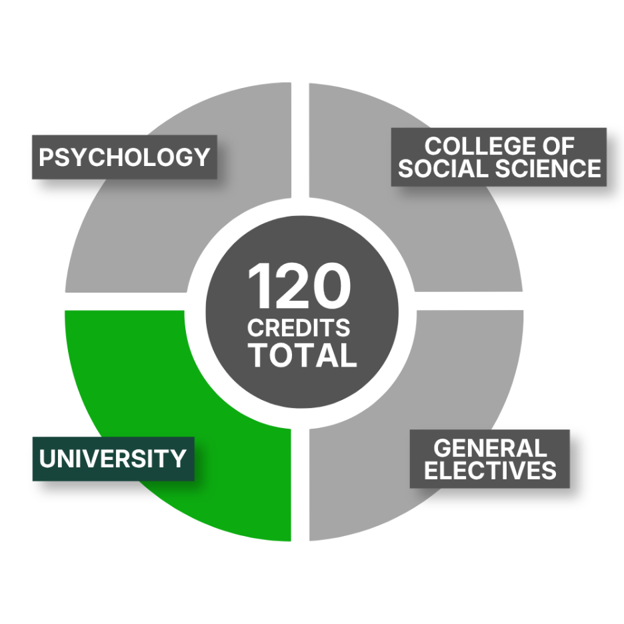
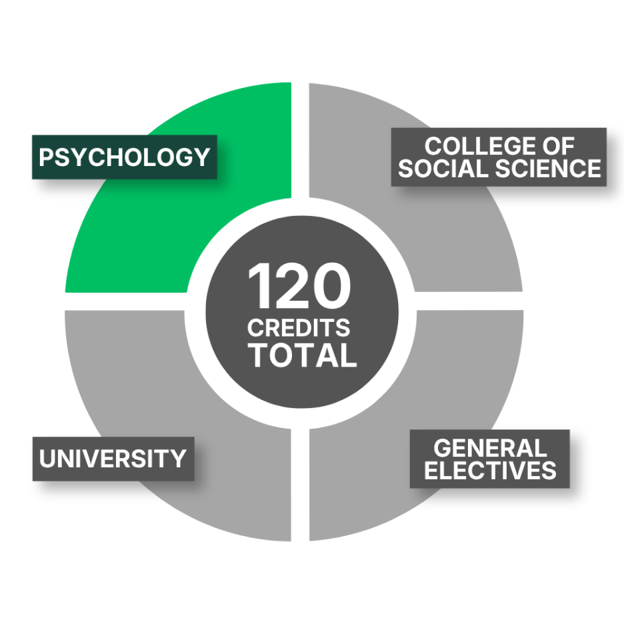
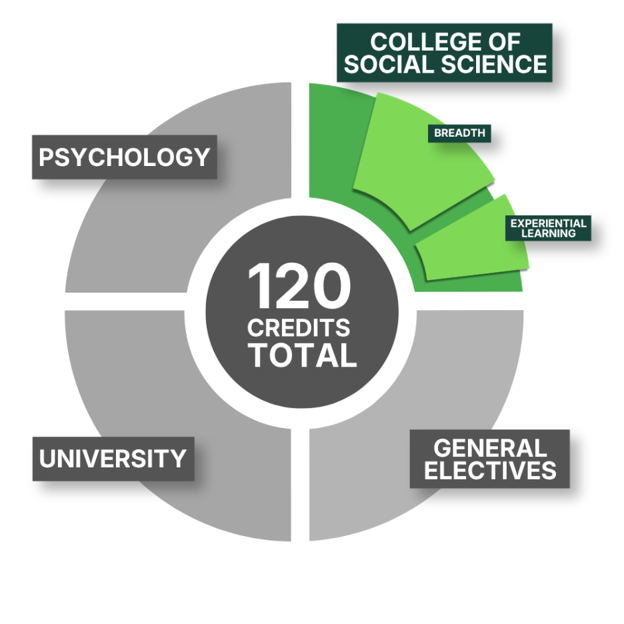
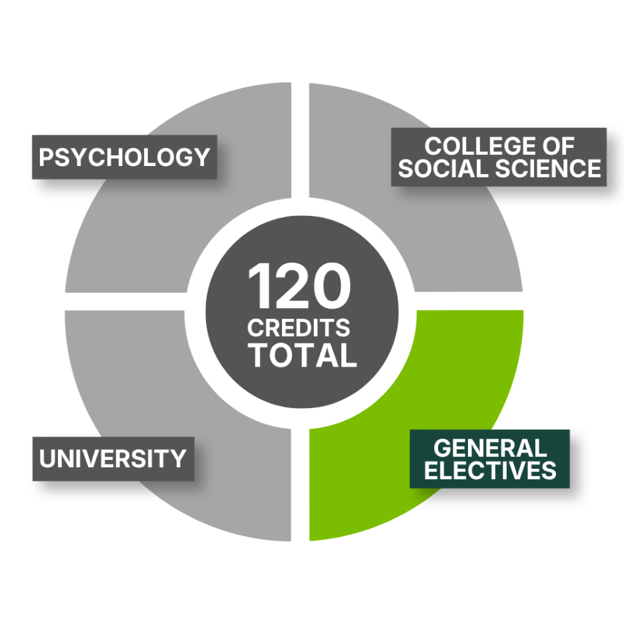
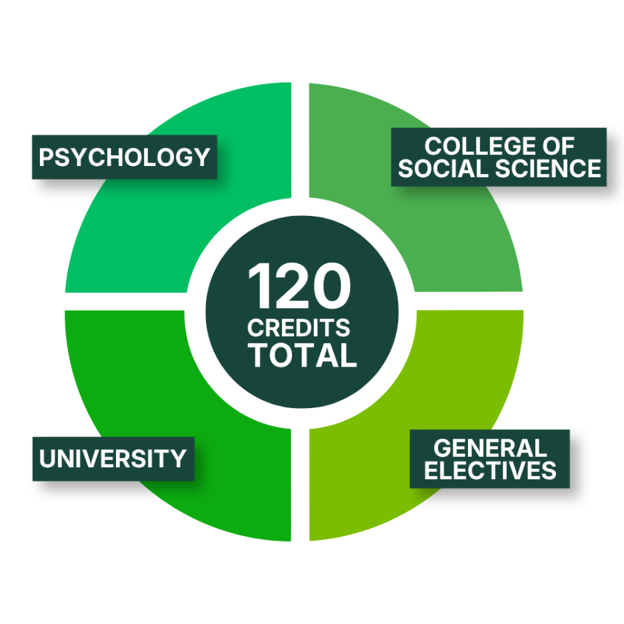
    Both Psychology degrees combine requirements from multiple areas including:

    • University requirements
    • College of Social Science requirements
    • Psychology major coursework
    • General elective credits


  • University
  • University Requirements

    PSY-degree-chart-uni

    Writing Requirement

    The Writing Requirement is completed in two tiers:

    • Tier I: WRA 101, 195H, or a waiver or credit from a high school exam (e.g. Advanced Placement, IB, etc.).  
    • Tier II: fulfilled by the completion of a designated course in your major (course titles are typically followed by a “W”).

    Mathematics Requirement

    Students are encouraged to begin math coursework early, as PSY 295 requires completion of the mathematics requirement before enrollment (usually during sophomore year). 

    College algebra is required for all PSY majors. Students who earn a 15 or higher on the MSU Math Placement Service Assessment may waive College Algebra.

    BA in Psychology

    Complete one of the following options (1 or 2):

    1. Complete both:
      • College Algebra: MTH 103, MTH 103A&B, or placement waiver
      • One additional course: MTH 101, 102, 114, 124, 132, 152H, or 201; STT 200 or STT 201

    OR

    1. Complete one:
      • College Algebra and Trigonometry: MTH 116 (5 credit fast paced course)
    BS in Psychology

    Complete both of the following (1 and 2):

    1. College Algebra: MTH 103, MTH 103A&B, MTH 116, or placement waiver

    AND 

    1. Calculus: MTH 124 or MTH 132
    Additional Major in Psychology

    Complete one of the following (1 or 2):

    1. Complete both:
      • College Algebra: MTH 103 or MTH 103A&B, or placement waiver
      • One additional course: MTH 101, 102, 114, 124, 132, 152H, or 201; STT 200 or STT 201

    OR

    1. Complete MTH 116

    Integrative Studies Requirement

    Students must complete 24 credits of Integrative Studies coursework across three areas:

    • Arts and Humanities (8 credits)
      • IAH 201–210 (4 credits)
      • IAH 211 or higher (4 credits)
    • Social Science (8 credits)
      • ISS 2XX (4 credits)
      • ISS 3XX (4 credits)
    • Natural Sciences * (8 credits)
      • (Biological Science) ISB 2XX (3 credits)
      • (Physical Science) ISP 2XX (3 credits)
      • ISB/ISP lab coursework (2 credits)

    * For PSY BS students, an Alternative Science Track allows approved science coursework (commonly CEM 141, BS 161, and BS 171) to fulfill university science requirements.

    Some flexibility may apply for transfer students who have not previously attended MSU.

    Diversity Distribution Requirement 

    Each IAH and ISS course is assigned a diversity designation (found at the end of its course title):

    • I = International Diversity
    • N = National Diversity
    • D = Multicultural Diversity

    Your IAH and ISS courses must include two different diversity designations out of the four courses taken: N, I, or D.

    Additional University Requirements

    Per university policy, the following graduation requirements apply: 

    • Complete a minimum of 120 credits with a 2.0 or better cumulative MSU GPA.
    • Achieve a 2.0 or better Psychology cumulative GPA at MSU.
    • Complete a minimum of 30 credits at MSU with a minimum of 27 credits on the East Lansing campus after junior year. MSU online courses are allowed in the 27 credits.
    • Earn a minimum of 20 credits while in the major.
    • Courses used to satisfy specific degree requirements may not be taken for CR/NC
    • Residency requirement: no more than 10 of your last 30 credits may be transferred without prior approval (usually reserved for study abroad seniors).
    • Up to 60 community college credits can be applied toward your bachelor’s degree.

    Note: Before taking a course at another institution, visit our Course Information page to learn more about other relevant policies.

  • Psychology
  • Psychology Major Requirements

    PSY-degree-chart-psy

    Complete a minimum of 31 credits in Psychology courses with a minimum of 2.0 PSY GPA.

    All course descriptions, restrictions, and prerequisites can be found in the MSU Course Descriptions. All PSY courses require PSY 101 as a prerequisite at a minimum.

    Core Curriculum (10 credits): 

    • PSY 101  Introductory Psychology (4 credits)
    • PSY 295  Data Analysis in Psychological Research** (3 credits)
    • PSY 395  Design and Measurement in Psychological Research (3 credits)

    Brain Fundamentals (Choose one – 3 credits):     

    • PSY 200  Cognitive Psychology (3 credits)
    • PSY 209  Brain and Behavior (3 credits)

    PSY Sub-Disciplines (Choose two – 6 credits):      

    • PSY 235  Social Psychology (3 credits)
    • PSY 236  Personality Psychology (3 credits)
    • PSY 238  Developmental Psychology: Lifespan (3 credits)
    • PSY 244  Developmental Psychology: Infancy Through Childhood (3 credits)
    • PSY 255  Industrial and Organizational Psychology (3 credits)
    • PSY 270  Community Psychology (3 credits)
    • PSY 280  Psychological Disorders (3 credits)

    PSY Tier II Writing Course (Choose one – 3-4 credits):

    • PSY 401  Expertise and Skill (W) (3 credits)
    • PSY 409  Psychobiology of Behavioral Development (W) (3 credits)
    • PSY 410  Neurobiology of Learning and Memory (W) (3 credits)
    • PSY 411  Hormones and Behavior (W) (3 credits)
    • PSY 413  Lab in Behavioral Neuroscience (W) (4 credits)
    • PSY 415  Neuroscience of Human and Animal Emotions (W) (3 credits)
    • PSY 424  Child and Family Psychopathology (W) (3 credits)
    • PSY 444  Developmental Psychology: Adolescence Through Youth (W) (3 credits)
    • PSY 455  Advanced Topics in Organizational Psychology (W) (3 credits)
    • PSY 493* Issues in Psychology (W) (3 credits)

    (W) indicates a Tier II Writing course.

    Required PSY Electives (9 credits minimum): 

    PSY Electives can include:

    • extra PSY courses from any of the lists above
    • 300-level and 400-level PSY Elective Courses
      • PSY 301  Cognitive Neuroscience (3 credits)
      • PSY 302  Sensation and Perception (3 credits)
      • PSY/NEU 310  Psychology and Biology of Human Sexuality (3 credits)
      • PSY 316  Children’s Exposure to Domestic Violence: Promoting Resiliency (3 credits)
      • PSY 317  Sexual Assault: Context, Interventions and Prevention (3 credits)
      • PSY 320  Health Psychology (3 credits)
      • PSY 333  The Neurobiology of Food Intake and Overeating (3 credits)
      • PSY 339  Psychology of Women (3 credits)
      • PSY 342  Stereotypes, Prejudice, and Discrimination (3 credits)
      • PSY/LIN 463  Introduction to Cognitive Science (3 credits)
      • PSY 492  Advanced Topics in Psychology (3 credits)
    • Departmental Experiential Learning Opportunities (instructor approval required):
      • PSY 490 or 491 – Independent Study
        • Undergraduate Research (1-12 credits)
        • Undergraduate Assistant (3-6 credits)
      • PSY 371 & 372 – Adolescent Diversion Program (6 credits)
      • PSY 382 – Internship
        • Human Service Internship Program (6-12 credits)
        • General Internship Program (3-12 credits)

    Bachelor of Science STEM Requirement

    In addition to the courses used to fulfill the University Natural Science Requirement, PSY BS student compete a minimum of 15 credits in Science, Technology, Engineering, and Mathematics (STEM) courses from the #6 list on this page.

  • College of Social Science
  • College of Social Science (CSS) Requirements

    PSY-degree-chart-col

    Breadth Requirement

    Students must complete one of the following:

    • A minor
      • Within the College of Social Science, or
      • Outside the College of Social Science
    • An additional major (coded as “ADDU”), or
    • A second degree (e.g., BA, BFA)

    To learn more about adding these options, please go to Adding minors, additional majors, and second degrees below.

    Experiential Learning Requirement

    All students must complete an approved 3- or 4-credit experiential learning activity before graduation. This can be completed within or outside the major.

    Common options include:

    • Internships
    • Undergraduate research
    • Service learning
    • Study abroad or study away
    • Honors thesis work

    See our Experiential Learning page to learn more. 

    Additional CSS Requirements

    • Complete a minimum of 30 credits in courses numbered at the 300-level and above.
    • The "12/12/20 Rule" applies:
      • You may apply up to 12 independent study credits, 12 internship/practicum/field experience credits, and no more than 20 total combined to your degree.
      • PSY 371/372 and PSY 381 do not count toward this limit.
    • Courses applied to University requirements may not also be counted toward the CSS graduation requirements.
    • Only credits in courses graded on the numerical, Pass-No Grade, or S-NS systems may be counted toward CSS and major requirements. In other words, courses taken for CSS and major requirements may not be taken on a Credit-No Credit basis.
  • General Electives
  • General Elective Requirement

    PSY-degree-chart-gen

    General Electives are courses that do not fulfill a specific University, College, or Psychology requirement. They are your opportunity to customize your degree.

    You will typically complete 19–34 elective credits, which count toward the 120 credits required to graduate.

    You can use electives to:

    • Explore new interests.
    • Build skills for careers or graduate school.
    • Complete a(n additional) minor, additional major, or second degree.

    Some electives (300+ level) can also help you meet upper-level credit requirements.

    Popular options for PSY majors include:

    • ADV - Advertising
    • CEP - Counseling, Educational Psychology, and Special Education
    • COM - Communication
    • HDFS - Human Development and Family Studies
    • HRLR - Human Resources and Labor Relations
    • KIN - Kinesiology
    • SOC - Sociology
    • SW - Social Work
    • TE - Teacher Education

    Electives can be broad or focused depending on your goals.

    PSY Academic and Resource Handbook

    PSY Academic and Resource Handbook

    The Psychology Undergraduate Handbook is your guide to:

    • Degree requirements
    • Academic policies
    • Experiential learning opportunities
    • Campus resources

    Important: Use the handbook from the year you started at MSU. Requirements may differ by cohort.

    Current Handbook: PSY HANDBOOK 2026-2027

    Archived Handbooks:

    • Psychology Handbook 2025-2026
    • Psychology Handbook 2024-2025
    • Psychology Handbook 2023-2024
    • Psychology Handbook 2022-2023 [pdf]
    • Psychology Handbook 2021-2022 [pdf]
    • Psychology Handbook 2020-2021 [pdf]
    • Psychology Handbook 2019-2020 [pdf]
    • Psychology Handbook 2018-2019 [pdf]
    • Psychology Handbook 2017-2018 [pdf]
    • Psychology Handbook 2016-2017 [pdf]
    • Psychology Handbook 2015-2016 [pdf]
    • Psychology Handbook 2014-2015 [pdf]
    • Psychology Handbook 2013-2014 [pdf]
    • Psychology Handbook 2012-2013 [pdf]
    • Psychology Handbook 2011-2012 [pdf]
    • Psychology Handbook 2010-2011 [pdf]
    • Psychology Handbook 2009-2010 [pdf]
    • Psychology Handbook 2008-2009 [pdf]
    • Psychology Handbook 2007-2008


    Adding Minors, Additional Majors, and Second Degrees:

    Minors

    • Explore a focused area of interest. Some are interdisciplinary, while others are department-based.

    Additional Majors

    • Combine Psychology with another discipline without completing a second degree.

    Second Degrees

    • Pursue a fully separate degree with its own requirements and diploma.

    Considering adding PSY as a second major or degree? Visit our Becoming a PSY Major page to get started. 

    Psychology Major Four-Year Plan

    We’ve created a sample four-year plan for a student completing a minor. While this can be a helpful guide while adding courses to your Shopping Cart, we strongly encourage you to connect with a PSY advisor for a personalized plan each semester.
    • Sample 1st Year
    • Sample 2nd Year
    • Sample 3rd Year
    • Sample 4th Year